
(rough draft podcast notes, need to be fleshed out)
The First Henry
for years, Dunbar was the “top sawyer” among the city’s sawmills. He graduated from this role to an examiner of woodlands in the Northwoods.
married April 12, 1892 to Mae Lewis, daughter of Oshkosh fire department Captain James D. Lewis
1899, moved to Ashland, Oregon, again to inspect timber
passed away in Ashland, Oregon in September 1901 from typhoid fever. He was 45 years old. His body was brought back to Oshkosh for burial. Much of his family was in Maine, but his brother Edward Dunbar lived in Oshkosh.
The Second Henry
Charles “Do Anything” Niles was an early stunt pilot, flying upside down and doing loops in his monoplane. He visited Oshkosh during the county fair on July 17-18, 1915. The Aero Club of America called Niles the greatest pilot in the world. Other pilots had tried and failed to do loops – Lincoln Beachy crashed and died trying in Appleton, for example.
Niles was back in Oshkosh on June 25, 1916. The weather and wind were not ideal, so he kept his stunts fairly modest. The large crowd grew upset and called him a “fake” and “yellow.” Niles refused to take the insults and went back up, completing his loops – but then losing control. He crashed into the ground, dying instantly. The newspaper the next day said the crowd were “savages” as they rushed the plane and tore off souvenirs – one person even stole Niles’ cufflinks from his corpse.
no fatal crashes for over a decade
Richard Lutz (1896-1965) joined the U.S. Army Air Service as an airplane mechanic in 1917, and in 1919, he traveled to Texas where he bought a JN4-D and barnstormed throughout the oil boomtowns. Lutz returned to Oshkosh in 1920 and started the city’s first airport with fellow pilot, Florian Manor, and the two teamed up to create a wingwalking act, with Lutz on the wing. In 1927, Lutz started a company, bought 100 acres of land on the south edge of Oshkosh, and established the airport that is still there today (now Wittman Field).
The Department of Commerce created an Aeronautics Branch in 1926. The first head of this organization was William P. MacCracken, Jr. (first recipient of its pilot certification license), whose approach to regulation included consultation and cooperation with industry. A major challenge facing MacCracken was to enlarge and improve the nation’s air navigation system. The Aeronautics Branch took over the Post Office’s task of building airway light beacons, and in 1928 introduced a new navigation beacon system known as the low frequency radio range, or the “Four Course Radio Range”. The branch also built additional airway communications stations to encourage broader use of aeronautical radio and combat adverse weather.
February 1928, the Oshkosh Yellow Cab taxi company purchased two airplanes from a business in Wichita, Kansas. Henry Dunbar and Robert Mensing, of the Oshkosh School of Aviation, were sent there to fly one of them back. Mensing was the experienced pilot, while Dunbar was going to learn the characteristics of the plane on the flight back. The trip was a bit more dangerous than expected, with a winter storm coming through the morning of February 22, but Mensing was able to land in Oshkosh at 2:30 that afternoon ona field that received one foot of snow. The trip required only one refueling stop, in Kansas City.

April 22 or 23, 1928, Dunbar, William Butzlaff and Robert Butzlaff were up in the taxi company’s new blue and silver biplane. Dunbar, as a student, would normally not be able to have passengers, but because the three men co-owned the plane, they were allowed to be there. They spent part of the afternoon circling the city of Oshkosh, which was a treat for both the airmen and those on the ground. They returned to land around 5:00pm.
Just south of the Oshkosh airport, the plane suddenly stalled and went into a tailspin from about 2,000 feet up. Moments later, it crashed – William and Henry were dazed and semi-conscious with what appeared to be only surface-level cuts and bruises, but Robert Butzlaff died instantly from a fractured skull. He was 29. Although people at the airport saw the crash as it happened, the location – a bushy field – meant it took around five minutes for the airport mechanics and paramedics to get there. The nose of the plane was partially buried in the ground, Dunbar was slumped over the controls and the two Butzlaff brothers were pinned inside the wreckage of the passenger cockpit.
Once removed from the plane, it was found that Dunbar had more cuts and likely a concussion, but was otherwise intact. The surviving Butzlaff brother, William, had actually fractured his knee and ankle in the crash – being passed out, this was not immediately obvious to the responders. Dr. AG Koehler handled the men at the scene and once they reached the hospital. To remove them, they had to be carried by hand across a swampy area and a shallow creek – the ambulance was unable to drive anywhere near the crash site.
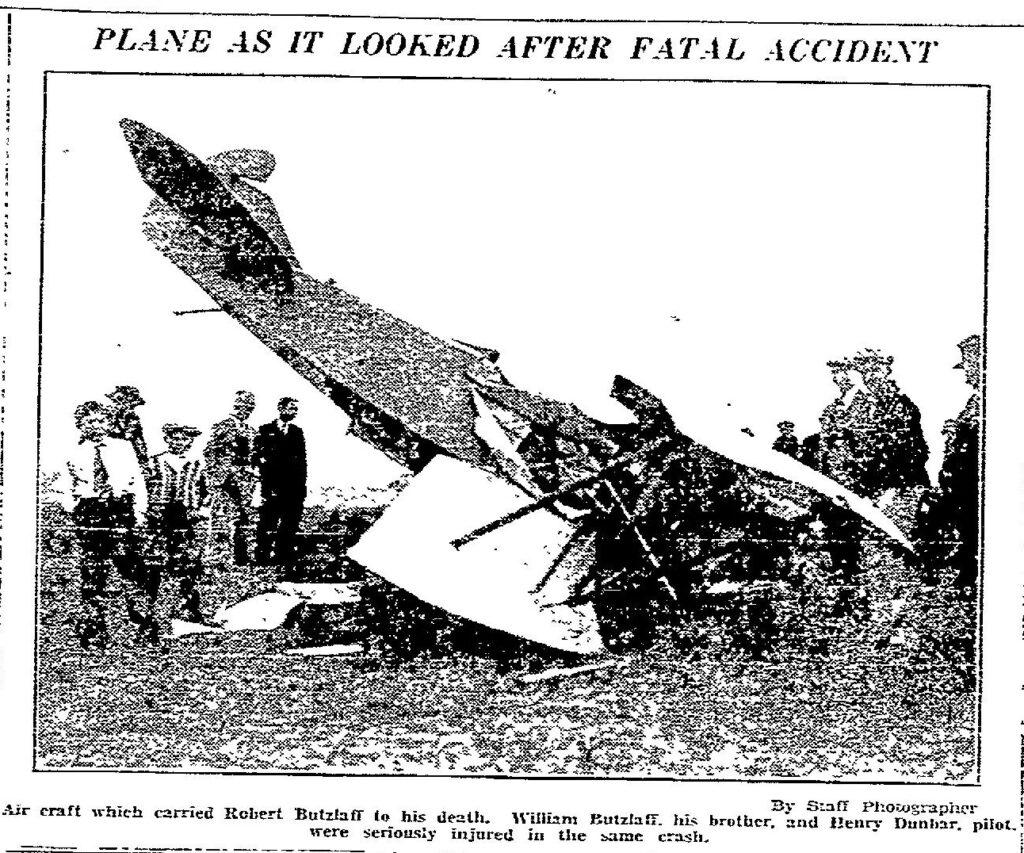
The three men lived together at the Butzlaff home at Route 1 in Oshkosh, all being related. While the incident was a tragedy, it was noted that at least Robert was a single man – he had no wife or kids to mourn for him like the other two did. The Butzlaff parents (William Senior) were in Minneapolis visiting their daughter Mrs. A. Kubjeski and did not know of the crash until later.
An anonymous pilot told the newspaper, “Tailspins, such as caused the wreck of the cab company plane are not in the least bit dangerous, provided the pilot keeps his head. In a descent of 2,000 feet, a pilot can easily come out of such a spin by a simple forward movement of the control lever. Dunbar must have become confused. Had he let go of the controls entirely, the plane would have ,in all probability, righted itself.”
Robert Mensing, Dunbar’s instructor at the flight school, was more generous and said Dunbar was a “careful and adept student.” He “has shown much skill in handling the plane and had finished the course of flying instructio nwith great credit.” Dunbar had 40 hours of solo flying and was waiting to receive his license. RW Lutz, president of the airport, also said Dunbar was a “promising pilot.” He pointed out that as an unlicensed one, he was not supposed to have passengers, but those rules could not be enforced if the passengers co-owned the plane.
Mensing was also on the panel of “board of examiners” who inspected the plane after the crash. The other two were Elwin West and Florian Manor – all three pilots for over a decade. They found that even after the crash, the controls responded correctly, so mechanical error could not be blamed.
April 24, brother Otto Butzlaff speculated that Robert gave his life for William. He said, “Bob always said that if anything happened he would throw himself in front of Bill. That is apparently what he did, for Bob’s body was found in front of Bill’s. By that, Bob took the full brunt of the blow and perhaps saved Bill being killed outright.”
The funeral for Bob Butzlaff was 1:00pm on April 26, and had a special tribute – three pilots flew over and dropped flowers as the body was being brought to the Doty Street Cemetery (today known as Peace Lutheran Cemetery on Waukau Avenue). The three pilots were Elwin West, David Read and Robert Mensing. Bill Butzlaff and Henry Dunbar were still in Mercy hospital and could not attend.
May 3, 1928, inspector James L. Kinney of department of commerce aeronatics division released his report. He palced the blame squarely on Dunbar – who he called inexperienced, unlicensed and operating an unlicensed plane. An anonymous official from the Department of Commerce said, “It is accidents such as this one that make it hard for us to put flying on a sound, safe basis. There would be fewer accidents – in fact, they would be reduced to a minimum – if prospective passengers looked up the record of the pilot and the plane before getting into the cockpit. People should demand to see the pilot’s license and the plane’s license before the takeoff.”
Dunbar was able to speak to the public on May 8. He said it was not his inexperience that crashed the plane, but the failure of the plane’s ailerons. He said he was in control the whole time, was never afriad, and planned to continue being a pilot.
September 21, 1932, Henry crashed again while transporting two Wadhams Oil employees, Claude Hurlbert and Arthur Darkow. All three received cuts and bruises but were able to walk away.
Moved to Lake Tomahawk
The Third Henry
married Shirley
lived in Fremont by 1966
owned Dunbar’s Supper Club near Fremont
Between November 4 and December 31, 1977, Dunbar took 10 or 11 trips to Silver Bay, Minnesota and back.
January 2, 1978 left Silver Bay around 3:45pm in a plane rented from Joel Sarnke of Waupaca. A few days earlier he had brought two men with him to Minnesota, but they were not on the return flight. A later report said he had 28 hours of flight time in this type of aircraft. His intended destination was Waupaca Municipal Airport, which required crossing over Lake Superior and going past Ashland and Wausau.
A few days after the plane went missing, the Wisconsin Civil Air Patrol urged snowmobilers to be on the lookout for a crashed plane. Knowing the plane would be north of Waupaca, it was felt that a search on snow may be more successful than well-traveled roads. Around 15 planes were making regular sweeps of the projected area, but visibility and weather conditions were not optimal.
By mid-January, the search expanded to the southern edge of Ironwood, Michigan. A resident there told authorities he saw a plane in trouble going down there around January 2. This would have been east of the expected flight path, but not impossible. (Ironwood turned out to be about 26 miles east of the crash site — would a plane be visible that far away?)
The plane and Henry’s body were finally found in the second half of April, around 10 miles west of Mellen in the Chequamegon National Forest in Ashland County. Tom Nelson of Ashland, who had a cabin in the area, was the one to find the wreckage. Dunbar was 50 years old.