
Vernon was built in 1886 in Chicago, by the shipyard owned by James P. Smith. Her wooden hull was 158.58 feet (some sources state 177 feet) in length, 25.42 feet wide and 18.66 feet deep. Vernon had a gross register tonnage of 694.94 tons and a net register tonnage of 560.41 tons.
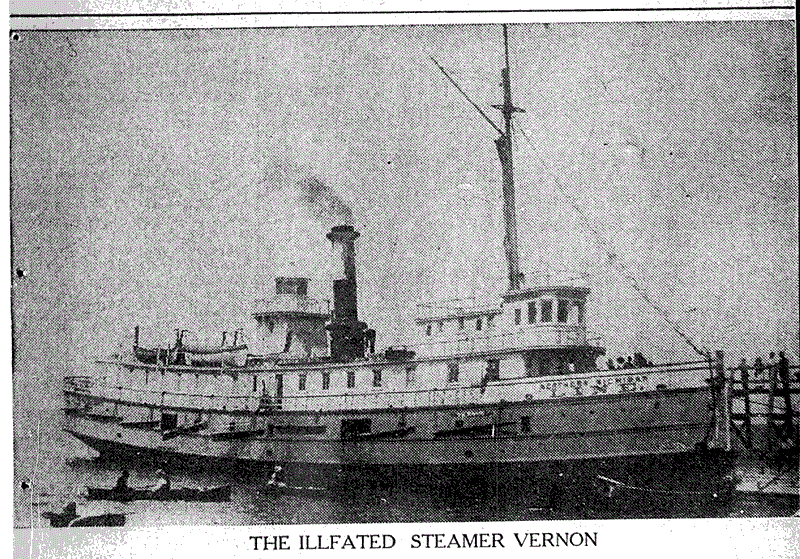
Vernon was powered by a two-cylinder 565hp fore and aft compound engine; the cylinders of the engine had bores of 22 inches and 40 inches and a stroke of 24 inches. Steam for the engine was produced by two 16-by-6.6-foot 125psi Scotch marine boilers. The engine and boilers were manufactured by the Marine Boiler Works in Chicago. She was propelled to a top speed of 15 miles per hour by a single fixed pitch propeller.
Vernon was built to carry passengers and freight from Chicago to Manistique, Michigan / Northern Lake Michigan in as little time as possible. She was regarded as one of the most elegant ships on the Great Lakes. Equipped with extensive brass fittings, eighteen state rooms and one very large cabin lounge, she cost $78,000 (equivalent to $2.34 million in 2023) to build.
Vernon had an abnormally deep draft when compared to her narrow beam, which caused her to become unstable when she was fully loaded. At the time of her construction, sailors criticized Vernon’s builders for sacrificing her buoyancy and stability in return for speed, predicting that she would “sooner or later meet with disaster.”
Great Lakes shipping expert Steve Harold wrote that:
“From the start, the Vernon was known to have an unusual, perhaps defective, hull design. Even when empty, she had an extreme draft and sat very low in the water. Some people later declared it was even unsafe for her to carry significant amounts of cargo because she was then dangerously low in the water.” Captain Edward Carus went so far as to describe the ship as a “freak” for its design, being too tall, too narrow and built almost entirely of Georgia pine.
Vernon was launched on August 16, 1886, in front of 5,000 onlookers. She was named after Vernon Booth, one of Alfred Booth’s two sons. She was built for Alfred Booth of Chicago, Illinois, and his sons, Edward and Vernon, each of whom owned a 1⁄3 share. She received her enrollment on September 1/2, 1886, in Chicago, which would also be her home port. That same year, she replaced the package freighter A. Booth (which sank August 29, 1886, near Duluth) in the Duluth–Port Arthur, Ontario, run on Lake Superior. For a time in 1887, Vernon was engaged in the iron ore trade, towing schooner barges between Lake Superior ports and Cleveland. While towing scow barges owned by John Pridgeon of Detroit, when she ran onto a reef in the Straits of Mackinac, causing damage to the barges. She was sold by the US Marshals Service to Pridgeon on July 22, 1887, as he had libeled her, due to the damage done to his barges. On August 6, 1887, she was repurchased by Alfred Booth for $23,350; and was then transferred to the Booth Fish Packing Company. That same month, she was chartered by the Northern Michigan Line, to replace their steamer Champlain, which burned down in Charlevoix, Michigan, on June 1 of that same year, with the loss of 21 (some say 22) lives.
Vernon left Chicago for Cheboygan, Michigan, on October 20, 1887, under the command of Captain George Thorpe, making stops along the way at Manitowoc, Suttons Bay, Michigan, and St. Ignace, Michigan. Reports conflict about the number of crewmen on board, giving estimates of between 23 and 25. In addition to Captain Thorpe, we know there was first officer John Sullivan, second officer Larry Higgins, chief engineer Charles Mascow, assistant engineer Frank Hall, purser Fred W. Burke and steward Martin LeBeau. (A purser is a senior officer responsible for all administrative, financial, and logistical operations aboard a ship, acting as the primary liaison between passengers and crew. Often managing passenger services, crew payroll, and cargo documentation, they act as the “banker” and office manager, ensuring compliance with maritime regulations.)
On her return trip, Vernon was bound from Cheboygan for Chicago and was once again scheduled to make stops at Mackinac Island and several other northern Lake Michigan ports. She left Cheboygan (or St. Ignace) at around 3:00am on October 26, accompanied by the package freighter Joseph L. Hurd and its captain, John M. Twitchell. Edward Carus was first officer for the Hurd. The two ships proceeded to Beaver Island, where Vernon boarded passengers and loaded freight, while the Hurd headed for Chicago. Vernon departed Beaver Island the following day, and passed Leeland, Michigan, at 1:00pm. She made a stop at Glen Haven, Michigan, and later at Frankfort, Michigan. On the evening of October 28, Vernon left Frankfort and headed across Lake Michigan to its Wisconsin shore. At around 10:00pm, Vernon encountered a northeast gale, which gradually worsened as she headed across the lake. Eventually, the large waves that made headway increasingly difficult, swamped Vernon, extinguishing its boilers. Now powerless, Vernon sank near Two Rivers, sometime between 3:00 and 4:00am on October 29. When Vernon sank, it was carrying a cargo of 400 boxes of fish, 90 tons of pig iron, apples, 2,000 bushels of potatoes, 90,000 barrel staves and other general merchandise.
Late at night the same day, the schooner Joseph Page (with Captain Williams) arrived in Milwaukee; it had encountered large amounts of wreckage from a “large, white propeller”, with several people clinging to it. The steam barge Superior encountered several life rafts and a yawl, which contained survivors who were signaling for assistance. Superior also encountered people floating in the water, wearing life jackets. Captain Moran of Superior identified the wreckage as Vernon’s, based upon the gold scrollwork unique to Vernon. The schooners Blazing Star, Horace A. Badger, William Home and the tug Anderson passed through a wreckage field, encountering several corpses. Moran later said “it was heartrending in the extreme to pass those shipwrecked people, how inhuman they must have thought us when we pass them by. We also were fighting for our own lives, our steamer having become disabled in the heavy sea, our tiller had broken out from the rudder post, and we were unable to steer. Our entire crew of 18 men, even the engineer, were down below making repairs. It took them five hours to rig up a temporary tackle and with this we managed to keep our vessel out of the trough of the seas, until we reached Milwaukee.”
None of the ships that passed through the wreckage stopped to assist the survivors. The first evidence that the wreckage was the Vernon was when the tug Maggie Lutz brought in some pieces and a life preserver marked “Vernon” to the Two Rivers docks.
Eventually, 19 bodies (17 men, two women) were recovered by the fishing boats Edith, Commodore Nutt and the Albatross on October 31; they were laid out in the Two Rivers fire station, which served as a temporary morgue. The two women were soon identified as sisters named Gallagher from Beaver Island; a third sister named Mrs. Green was never found. Initially, it was assumed that 50 people died onboard Vernon. This number was later revised to 36–41 lives, as several passengers disembarked at the ports where she stopped. Nine corpses were not identified; they were photographed and then buried at a Two Rivers cemetery. The high toll makes Vernon one of the deadliest shipwrecks ever in Wisconsin. She was valued at $75,000 ($2.25 million in 2023).
Initially, it was believed that no one onboard Vernon survived. However, on October 31, the schooner S.B. Pomeroy (with Captain Comstock) which was bound from Chicago for Green Bay discovered a life raft six miles offshore of Sheboygan with two men on board. One had died from exposure, meanwhile the other one, 23-year-old Swedish fireman Axel Stone had survived. The Pomeroy transported him to Green Bay, where he recounted the details of the disaster to the local newspaper. Stone claimed that Vernon was overloaded, to the point that less than 6 inches of freeboard remained above the waterline. He reported that due to the excessive load, Vernon’s crew were unable to close the gangways. According to one source, the 50 hours aboard the raft had “weakened his mind” and his account was a bit delirious – Stone died two months later.
An inquest held on November 7, 1887, stated that the storm of October 29 was not so fierce nor the lake so rough as to prevent the rescue of these bodies. If their perilous condition had been known, the life-saving crew, each and all of the five fishing tugs here, besides many small boats would have gone promptly to their rescue.
As part of the inquest, the captains of Joseph Page and Superior were reprimanded for not making more of an effort to save the survivors.
The wreck of Vernon was located in 1969 by Kent Bellrichard of Milwaukee. It rests intact in 210 feet of water, northeast of Two Rivers, keeled over to starboard side. Its pilot house and cabins which broke away when it sank, lie west of the wreck in 160 feet of water. Her cargo is still intact within her hold. Her gangways are still open, confirming Axel Stone’s claims of her crew not being able to close them due to her excessive load. Various artefacts, including her name board are on display at the Rogers Street Fishing Village in Two Rivers.
A monument commemorating eight of the people who died onboard Vernon stands in Pioneer Rest Calvary Cemetery in Two Rivers.
Those onboard:
1. ALBERS, WILLIAM from Saukville, Wisconsin
2. BAUMGEAS, C., from Chicago
3. BORLAND, EDWARD B. (35), Drug Salesman for Bosworth & Sons. He leaves a wife and three children living in Chicago
4. BURK, FRED W. (21), Clerk, Oldest son of Mr. Burk, one of the part owners of the Vernon. From Des Plaines, Ill
5. COLLINS, Mate, Captain. Formerly sailed schooner Golden West
6. CURTIS, from Zeitz, Germany
7. DUNLEVY, MISS, from St. James, Beaver Island, Michigan
8. DURKIN, MISS SALLIE, from Chicago
9. DUTCHER, BILL, Deck Hand,
10. GALLAGHER, CHARLES, from St. James, Beaver Island, Michigan
11. GALLAGHER, MISS KATE, Vernon, †29/10/1887, From Mackinac Island, Michigan
12. GREEN, MRS. BRIDGET, SS Vernon, †29/10/1887, Sister to Kate Gallagher
13. HALL, FRANK M. (35), Second engineer, Vernon, †29/10/1887, Brother of Ed Hall of Chicago
14. HASELBARTH, ADOLPH, Vernon, †29/10/1887, From Milwaukee
15. HAZELTON, ROY (22), Cabin Boy, Vernon, †29/10/1887, From Chicago
16. HIGGINS, LARRY (40), 2nd Mate, Capt., Vernon, †29/10/1887, Captain. Formerly sailed steam-barge Leland
17. KETCHING, Vernon, †29/10/1887, From Grimsby, England
18. KROPP, CHARLES, Part owner in pier at Good Harbor, Vernon, †29/10/1887, From Good Harbor, MI
19. LE BEAU, HENRY (20), Porter, Vernon, †29/10/1887, Brother of Martin. Both having been on the Champlain when she burned
20. LE BEAU, MARTIN (30), Steward, Vernon, †29/10/1887
21. MARCOUX, CHARLES (45), Chief Engineer, Vernon, †29/10/1887, He had sent in his resignation letter to the company, and this was to be his last trip. He leaves a wife in Chicago
22. RIGGS, GEORGE, Engineer on the tug Robbie Dunham, SS Vernon, †29/10/1887, Was moving his wife and family to Chicago from Sheboygan
23. RIGGS, MRS. GEORGE AND THREE CHILDREN, Vernon, †29/10/1887, Relocating from Sheboygan with husband and children
24. STONE, AXEL, Watchman, Vernon, Sole survivor found floating on a lifebuoy. He had been in the water for about 48 to 50 hours. From Chicago
25. SULLIVAN, JOHN, First Mate, Capt., Vernon, †29/10/1887, from Chicago
26. TEBEAU, LOUIS, Vernon, †29/10/1887, From Charlevoix, Michigan
27. Captains THORPE, GEORGE (30), Captain, Vernon, †29/10/1887, Of Ogdensburg, N. Y
28. VIOLET, CURT, Vernon, †29/10/1887, Known as Chas