
Ralph E. Ritschke was born around 1963, to Duane Allen Ritschke (1935-2016) and Shirley Ann Stroud (1934-2005). He had been from Oshkosh originally, moved to Omro and then again to Wittenberg, where he graduated high school around 1981.
March 20, 1984, 21-year-old Ritschke was arrested for criminal damage to property and released on a $500 signature bond. He was accused of damaging a window at the D&M Liquor Store at 731 East Wisconsin Avenue in Appleton.
April 7, 1984, Ritschke started drinking in the afternoon at home. He called his girlfriend twice, who informed him that she was pregnant. He then called a friend in Oshkosh, and said he was drunk and was thinking of hurting himself or someone else. He spent the evening at various taverns, and would later register a blood alcohol level of 0.19 (elevated, but not quite double the legal limit). At some point, he allegedly watched The Prowler, a 1981 slasher film directed by Joseph Zito and featuring special effects from Tom Savini.
After bar close, around 3:50am, Ritschke went to the five “small, efficiency” apartments over Discount Liquor at 215 West Wisconsin Avenue and people heard him running up and down the hallway, knocking on doors. Ritschke went to 38-year-old Robert G. Wettstein’s apartment, and soon neighbors heard screaming and Wettstein yelling “stop it!”
Wettstein was known as “Bicycle Bob,” and was well-liked in the community. He was described by others as “a really nice guy” who “never bothered anybody.”
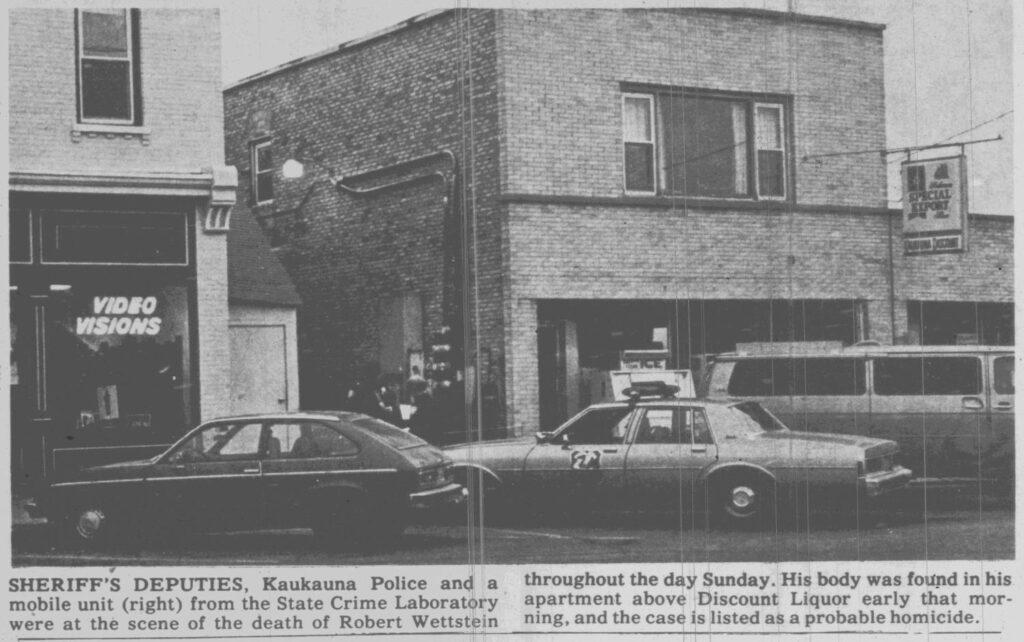
After 4:00am, Ritschke returned to 323 West Taylor, the home of Glen “Red” Ball, where he had been staying in a rented room. Ritschke was employed part-time by Ball in “carnival work.” Ritschke woke Ball up and told him what had happened – he had just killed a man. He had blood on him, including two blood-soaked gloves, so Ball had no reason to doubt him, and called the police around 4:41am.
When police arrived, Ritschke told them he had spent the day drinking beer and had “nine tablets” of amphetamine before committing the crime. Patrolman John VanDrunen was the first to arrive, and found Ritschke casually drinking a beer and smoking a cigarette. He said he knew what he did, but was blacked out during the incident. He said, “I killed him. That’s the first time I ever done it. God, I did it.” When police brought him back to Apartment 2 (to verify the murder), Ritschke fainted. According to VanDrunen, a pool of blood extended out two feet from the closed door. Wettstein was found on the floor, shirtless, and blood was throughout the apartment. At one point during the arrest, Ritschke said, “I did it. I killed him for Red. Red needed $300 to get out of jail.”
Police from Kaukauna, Appleton, the state crime lab and the county sheriff’s office spent the night at the crime scene. In total, they were at the apartment for roughly 12 hours. (At the time, Appleton and Outagamie had a combined “Outagamie County Major Case Unit” – I’m not sure if that’s still a thing.)
Coroner Phil Russell pronounced Wettstein dead at the scene but did not immediately release a cause of death. He told reporters the body was transported to Madison where forensic pathologist Robert W. Huntington III would do the autopsy. Russell said there were “serious injuries” to the upper torso and neck, but it would be improper to make a firm determination before the full examination. The autopsy concluded Wettstein bled to death from a stab wound to the neck. There were multiple stab wounds consistent with a knife blade.
John Mau of Mau Realty, landlord for the apartments, spoke highly of Wettstein, saying he had been a renter for several years and acted as sort of an unofficial on-site manager, helping with repairs. He would also paint the apartments, shovel snow and rake the leaves. Mau said Wettstein was “responsible” and “exceptionally clean.”
Wettstein’s mother, Ethel Wettstein of 807 Draper Street, was understandably distraught. She said Bob had injured his back 10 years earlier at a cement company in Green Bay and made his living from doing odd jobs. He was especially helpful to his parents. Her husband (Bob’s father) had been quite sick, and Bob would come over and shave him, in addition to other chores.
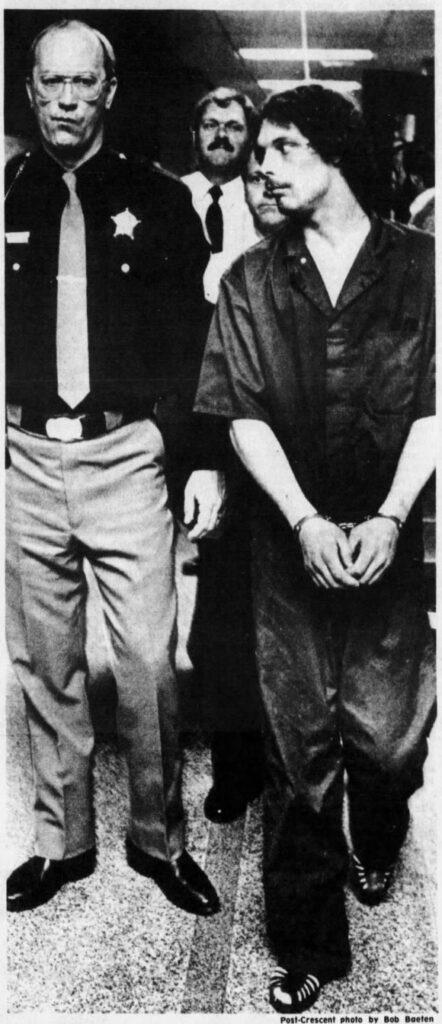
At his initial appearance the next day, Ritschke was held on $100,000 bond under the charge of party to first-degree murder by District Attorney Michael Gage and Court Commissioner Jeffrey S. Brandt. Gage explained that there was effectively no difference between first-degree and “party to” first-degree, as they both resulted in life imprisonment. He was merely leaving the door open in case a second suspect emerged. Public defender Michael Dally asked for the bond to be reduced to $10,000, but this was denied. Commissioner Brandt noted that Ritschke had been in Kaukauna for only a few months and his employment was seasonal, so he could be considered a flight risk. Gage told the press it was not immediately known if the two men knew each other before the murder. A motive wasn’t immediately disclosed. Rumors circulated that a few items were missing from the apartment, but nothing of any value that would strongly suggest a robbery.
At Bob’s funeral on the Wednesday following his death, an anonymous friend said, “He left us with the kindnesses he showed to others. He left gentle words, and he showed us how to turn the other cheek. He left a legacy of hard work and charity. Many of us are angry as well as saddened at the way in which he was taken from us but think what he would say to us now. I think he would want no one to be angry, bitter or sad. He would want no one to think a violent or harmful thing against another human being, especially on his account. I know he is at peace, and I think he would want us to be at peace, also.”
The press spoke to various people around town who knew Wettstein. John Mau said, “He was quiet and reserved, not an abusive or overly aggressive type. He watched out for things.” Grace Spice, bartender at The Bar on Wisconsin Avenue, said, “I don’t thin ka day went by that he didn’t do something for somebody.” She mentioned how he had two bikes until recently, when someone stole his tandem bike, which he was very proud of.
Dave Longsine, bartender at Club Ritz, said Wettstein was honest. He pointed to a watch that Wettstein gave him as collateral for a $10 debt. For even such a small amount, Wettstein wanted people to know he was coming back. Sue Cummings at Sully’s on Wisconsin Avenue said, “He’d buy a pitcher sometimes during Happy Hour” and would share it with others. Discount Liquor employee Barb Wittmann noted that he often bought children candy and “was like a child himself.” Bob’s mother said he was fond of children because he couldn’t have any – this is what lead to his divorce in his 20s.
Bob was survived by both his parents, as well as four brothers and two sisters. His father Norman relied on him for odd jobs, and even for shaving, because Norman had developed Parkinson’s Disease. Many others relied on Bob to do small repairs, and what they paid him supplemented the $400 per month disability checks he received. Rev. Mike Hoffmann officiated at the funeral.
Preliminary hearing on April 18 and bound over for trial by Judge James Bayorgeon. The primary witness was Dr. Huntington, the pathologist. He testified that Wettstein had already bled to death from a slit jugular vein before another five stab wounds entered his chest. Whoever killed Wettstein did not do so accidentally – it was excessive. The stabs were also very forceful – some of them went through the sternum and two pierced the heart, not an easy task. Huntingdon said they were “dry” wounds, meaning that the body had lost so much blood that even piercing the heart did not cause any additional bleeding.
May 30, reserve judge DH Seborah disqualified himself, delaying the arraignment until June 22. Judge Nick Schaefer was now assigned. Public defender Michael Dally spoke to the press the same day, letting them know a not guilty because of mental illness plea was being considered.
Bob was memorialized in the June 1984 newsletter for the Brothertown Nation. The article covered who he was and what happened, as well as quoting a friend at length. The newsletter revealed that, according to Brothertown genealogist Rudi Ottery, Wettstein was a direct descendant of Eliphalet Mathers, one of the first Brothertown in Wisconsin. He was also related to many others.
June 22, Ritschke was arraigned before Judge Nick Schaefer in Branch III of Outagamie County. Defense attorney Dally filed eight motions, including request for change of venue, pointing to the extensive media coverage. The defense claimed that people in Kaukauan said they would “personally seek retribution” against the defendant. Ritschke declined to plea at this time and Judge Schaefer entered a plea of not guilty, with the possibility it could be changed later. The possibility of mental defect was still in play, as they were awaiting an examination by Dr. Burr Eichelman of Madison. Unnamed sources told the Post-Crescent that Ritschke would claim he watched a movie called “The Prowler” on TV shortly before the stabbing, and in his mental instability he tried to copy a scene from the film. The trial was set to begin with jury selection at 1:15pm on September 10.
July 19, while at the Outagamie County Jail, Ritschke cut his left wrist with a razor in an apparent suicide attempt. Prisoners are given safety razors for shaving, but he managed to break it apart without a guard noticing. He was treated at St. Elizabeth Hospital and then returned to jail. Later, it would be claimed by a friend of Ritschke’s that this was an attempt to build up the insanity defense.
August 8, the trial was pushed back from September to October 15 to allow more time for the state crime lab to process evidence. The first open date was in November, but Judge Schaefer rearranged another case to move things ahead. “I’m trying to give this higher priority,” he told the attorneys. The defense also indicated they would not be seeking an insanity defense. The motion hearing was set for August 24.
On August 24, Judge Schaefer threw out five motions citing various reasons to dismiss the case. These were various claims like “insufficient evidence” and the defense being unable to cross-examine at the preliminary hearing. The motion to change venue was delayed and not addressed.
September 14, Ritschke agreed to plead guilty if charges were lessened from first-degree to second-degree murder. He was informed that the state would ask for the maximum sentence available for a second-degree murder conviction. DA Michael Gage and defense attorney Michael Dally agreed on this, and Judge Nick Schaefer set sentencing for October 16. A presentence investigation was ordered. Gage told the press he was satisfied with this outcome, as it saved the taxpayers a trial, ensured a substantial prison sentence, and was a charge in line with the crime. (With a first-degree charge, the defense could have argued there was no pre-meditation or that Ritschke acted in a moment of passion, risking an acquittal from the jury.)
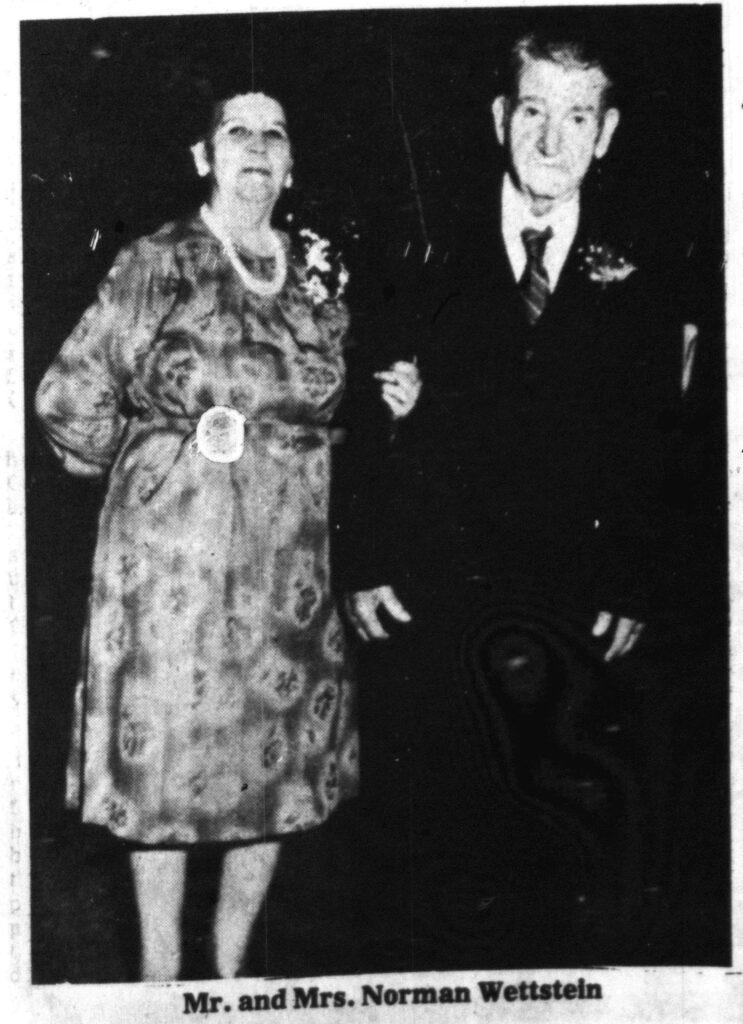
September 22, while waiting for sentencing, Norman and Ethel Wettstein celebrated their 50-year wedding anniversary. A dinner was held at Jacks or Better in Little Chute, and a reception was held after at the VFW Hall in Appleton.
October 16, the sentencing was delayed until October 24, allowing more time for a presentence investigation.
October 24, Ritschke was sentenced to 20 years in prison, beginning at Dodge County Correctional. In fact, with good behavior, he would be released after 9 years, seven months and 21 days. Judge Schaefer said this was the maximum penalty for the charge and it was warranted because the crime was “aggravated” and “vicious.” He read from the presentence report that Ritschke had a drinking and drug problem, suffered physical abuse as a child, had no father figure, was “borderline mentally retarded” and allegedly suffered from multiple personality disorder. On this last point, the report said he also had a history of attempting to “manipulate psychologists.”
Ritschke addressed the court, saying, “To my way of thinking, my only problem is drinking. They may see me as a danger to society, but the only way is if I’m drinking or into drugs. I’m sorry this thing happened. I did not intend to do it. That’s all I have to say.”
July 1986 (almost 2 years later), Ritschke petitioned to change his plea from no contest to not guilty, arguing that Judge Schaefer did not properly explain things to him. A reading of the transcript showed otherwise, and Schaefer denied this petition.
Note: I’m almost positive I requested the investigation file on this case, but never heard back. This is an area to pursue in the future.