
(these are podcast notes and should not be taken as a complete, edited and polished article)
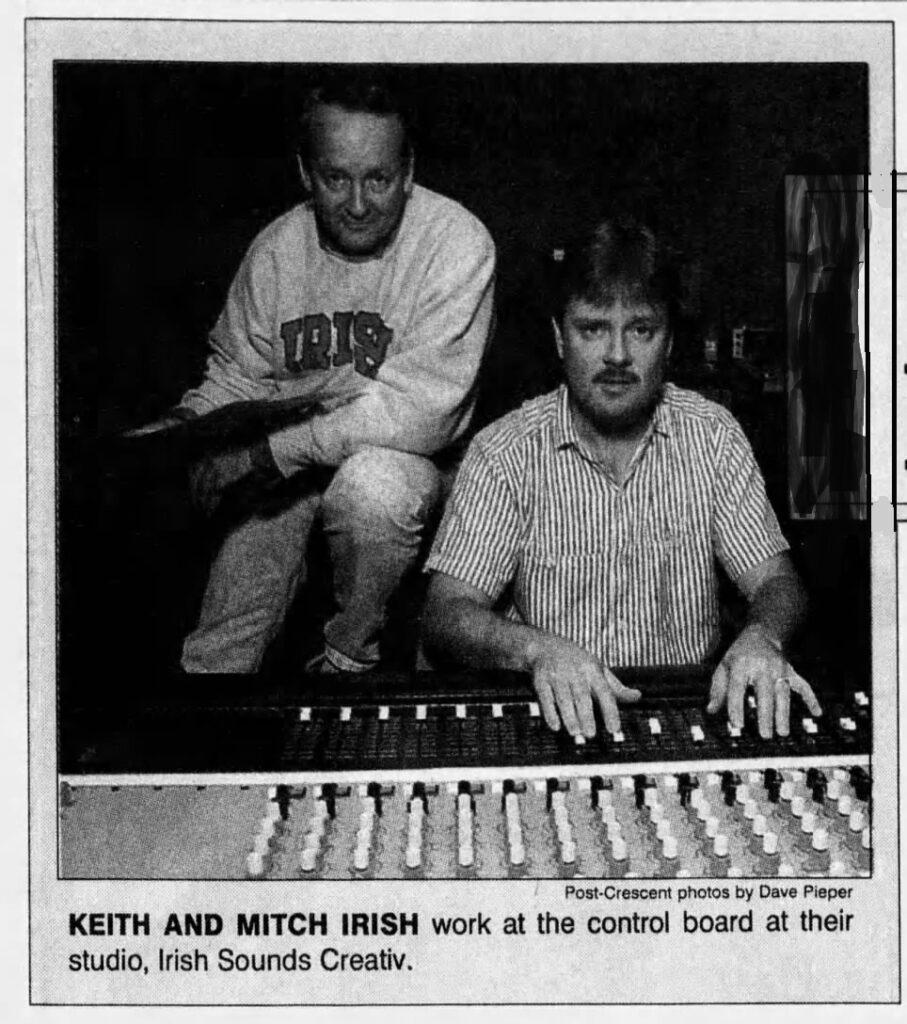
Founded 1974ish by two former teachers and a university music student. Ed Saxe had taught English and math at Fredonia’s Ozaukee Middle School, and now handled sales and lyric writing. Keith Irish taught at Clayton and Roosevelt elementary shools in Neenah but now focused on engineering and technical work. Mitch Irish, Keith’s brother, composed and arranged the music, and did the singing. The studio was originally assembled from second-hand parts from other studios. They proudly noted that some of their parts were used to create the Quasar television theme.
Keith later reflected, “Mitch had the musical aptitude and he liked to do all the technical stuff like overdubbing and reverb, while I liked to do the creative stuff, like writing lyrics.”
The first client was in the early summer of 1974, a “Neenah eating place” (not further identified).
March 1976, Irish Saxe Sound Productions was located in the basement at 929 Reddin Avenue in Neenah, the home of Keith Irish.

In March 1976, Ed Saxe said, “I don’t think many people even know we’re here.” He pointed out that they have never advertised. However, they were the only business north of Milwaukee fully equipped to write, produce and record radio and TV jingles. Their work could be heard as far north as Rhinelander and as far south as Oregon, Illinois. They were soon expected to be broadcast in six states thanks to recording they did for a home dealership in Mercer. “We work very well together,” Saxe said. “We communicate effectively… We want to grow and we have grown.” At this point they had handled 80 clients including car dealers, home construction companies, restaurants, banks and others. “You can’t imagine the work that goes into producing a commercial jingle… What we do is a very personal thing, so we try to create a personal statement for a client, a reflection of his business philosophy. In order to achieve that, we need to understand who our client is so that we can tap into his philosophy musically… We don’t do any business by mail or telephone. All contacts with prospective cleints are on a face-to-face basis. That’s our policy.”
Keith Irish said, “We know how much a jingle can do to give a client listener identity. We are already competing with firms in Milwaukee, although perhaps they don’t know it yet… What keeps our work fresh, I beleive, is our willingness to say ‘no’ to the obvious. Within certain limits, we like to experiment. And it’s when we’ee successful at experimenting that the work becomes so exciting.”
Mitch added, “We know what kind of melodies will work for a specific client. To me, the melody is everything. I’ve never yet put out a melody that doesn’t seem right, and I never will. If the melody is simple and catchy, it’s probably a good jingle for someone. But a jingle which is right for one client may not be a good one for another company. It all depends upon the image the client wants to protect.”
At this point (March 1976), Irish Saxe had a “pool” of around 20 musicians and singers from within the range of Green Bay, Fond du Lac, Manitowoc and Wuapun. They drew primarily from UWO, Lawrence University and St. Norbert College. Those publicly identified were: Jim Hendrick, Bill Graves a d Tom Gunther of the Neenah rock band Friends; Do Schindhelm and Nancy Johnson of Appleton; Patty Holzman of Green Bay; Sandy Schmitz of Fond du Lac; and Linda Hofacker of Kaukauna.
1977, Irish Saxe officially incorporated according to later news articles, though the state says this did not occur until September 1982.
Detour: Exit Dying and Timing Run (1978). On April 23, 1978, Mitch Irish and the Rose Canton Band gave a free concert in Shapiro Park to promote “Timing Run Inc,” the fundraising arm of UWO Professor Bob Jacobs’ attempt to make a feature film. Another article said Mitch performed the main theme of Timing Run, though whether it was ever actually recorded, I don’t know. (This will be covered elsewhere.)
January 1979, the studio is still identified in articles as being in Neenah, so presumably still in the Irish basement. Around this time, Irish Saxe stenegthened its bond to Lawrence University, utilizing entire bands in their recordings. Fred Sturm, jazz director at Lawrence, said, “Composer Mitch Irish and others at the recording studio have been extremely cooperative in helping Lawrence students gain valuable practical experience in the area of commercial arranging.” Interestingly, the studio was not big enough for the band to fit, so instruments had to be done in shifts and then layered on the mix. This is not unusual, but was not how the students were used to playing a song.
Around 1979, the studio was involved in the Bill Rebane movie “Capture of Bigfoot,” filmed around Gleason, Wisconsin. How they became involved is unclear, but Mitch Irish even appears on screen. Credits for two songs on the soundtrack show that the sonds were written by Keith Irish with assistance from Ed Saxe, and Mitch Irish sings “My Spirit Runs Free.” Vocals on their other song, “Sensuous Tiger,” come from Patti Holzmann.
The studio appears to move in mid-1979 to 1719 West Washington Street in Appleton. The building was under construction at the time, so the contractor was able to design their portion as a studio from day one.
The “save big money” Menards jingle was created around 1980, though some sources suggest 1982. 25 years later (2000), Ed Saxe recalled, “That’s the most important advertising that Menards does. I have a million stories about people’s relationships to that jingle.”
By autumn 1981, Irish Saxe had done over 600 jingles and was now recording “Packer Playback,” or what they called “Packer raps,” to play following each Green Bay Packer game. The songs would summarize what happened in each game. Keith Irish said they were inspired after doing some work for John Steinmiller, publicity for the Milwaukee Bucks. Music was styled off the teams they played. Keither noted that they did country when the opposing team was Atlanta, and did a Beach Boys style for Los Angeles. The singers for these “raps” were Larry Darling and John Harmon of the band Matrix, Tommy Guenther and Bill Graves of Friends, and Ken Anderson and Barbara Simon.
The music is written first, and Keith writes the lyrics while watching the game, noting the play-by-play. Recording sessions could be as short as three hours or go until 2 in the morning. Then cassettes of the finished product are sent out to WHBY, WLUK, Channel 7 in Wausau, Channel 15 in Madison and WTMJ in Milwaukee. The songs were popular and soon the Minnesota Vikings wanted songs done for them, too. Ed Saxe noted the football songs were not very profitable but “open a lot of new doors” for the studio. Regarding the new Vikings contract, Keith Irish said, “I feel like the ultiamte hypocrite. And when Green Bay plays Minnesota I’ll have to do it from two slants. It should be a riot. We’ll have fun with it.” Later reports suggest 12 teams approached them soon after, and Keith later commented, “If it wasn’t for the 1982 NFL strike, we would have all collapsed and died from exhaustion.”
January 1985, Lawrence University senior Patty Schultz recorded “Gusandaya” at Irish Saxe. This recording was submitted as part of a selection of Lawrence Jazz Ensemble pieces for the Dee Bee Awards. Lawrence was identified as one of the best jazz groups (top three) in the country.
In 1987 and 1988, Irish Saxe was a sponsor of the country music band contest at the Jim Falls Sturgeon Festival. In 1987, R Country Gals won $500 worth of recording time. In 1988, someone won six hours of recording time.
On March 18, 1988 as part of “Music in Our Schools Month,” Irish Saxe recording engineer Larry Darling spoke with students at Electa Quinney Middle School in Kaukauna.
Bob Bodmer involved in the 1980s(???)
Saxe Productions (1988-) and Irish Sounds (1988-)
In September 1988, Ed Saxe split off to form Saxe Productions in Grand Chute. Scott Saxe (son?) joined the business. Irish Saxe changed its name to Irish Sounds Creativ.
1991, Irish Sounds considered using 6,000 square feet of vacant space in the building they had to expand to video production for television. They were sending out 50 radio recordings each week, and estimated that they had done 15,000 jingle overall at this point. Two popular ones at the time were Fox Valley Greyhound Park’s “Fun, fun on the run” and American TV’s “It’s gotta be good.”
In addition to splitting, more competition came around by 1991. Jim DeKoch, who also had a home studio in Appleton, told the newspaper that sound equipment was getting cheaper all the time and a 4-track studio could be started for as low as $500. One of the biggest reasons for the change was Musical Instruments Digital Interface (MIDI), which provided a lot of versatility with nothing more than a keyboard.
By 2000, the recording engineer at Irish Sounds was Jim Hendrick.
Interviewed in 2000, Saxe said, “I take what I do really seriously. I make sure the client knows the fundamentals, and I make sure it’s done right.” He was proud of the talent pool created. “The (local) singers are as good and sometimes better than singers in Chicago. Frankly, I think they could be singing anywhere. I just got lucky that they live in Oshkosh or Green Bay.”
Keith Irish said, “Normally, people who work full time in music need something else to do.” A great example of this was Janet Planet of Oshkosh, who was a regionally-famous club singer for 20 years at that point. She was a full-time singer, sold her own albums, and made ends meet by recording jingles twice a week. She said, “It keeps me working. It keeps my thought process in that arena.” Planet said in some ways jingles are more acting than singing, explaining, “I’ve sung everything from gangsta rap to country. When I finish a session, I’m hard-pressed to tell you what I’ve been singing for the past two hours.”
Another singer who had worked regularly for the Irish brothers for 25 years was Nancy Ullsperger of Appleton, who used it to supplement her income from working at Club West and playing in the Christian band For a Reason. Yet another was Tim Dorsey, who was just as famous (if not more so) than Janet Planet. He said, “I’m a kid of the TV age. I always cued in on commercials and on how they work. You have to get a message across in a short period of time. That appeals to me.”
Jingles paid varying amounts depending on the client, the singer and other factors. According to a 2000 article, a singer could be paid between $100 and several thousands dollars for one jingle. The catch was that singers received no royalties. If a jingle hit it big (e.g. Menards, Stein Garden and Gifts) it would bring in no extra money for the performers.
From July 1999 to 2009, Keith also ran Creativ Software out of the Washington Street location.
In 2006, the business briefly changed its name to Mic Productions, Inc before going back to Irish Sounds Creativ. The corporation was dissolved by the state in 2011. Keith started a new business, Irish Creative, that same year, which was then dissolved by the state in 2023.
MIDI-West Music Composition and Recording (1989-)
In July 1989, Irish Saxe recording engineer Larry Darling split off and started MIDI-West. He brought in John Gibson, a local bassist, to work as sound engineer.
1991, they told the press, “Within the next year and a half, the main growth we are going to see is in soundtrack work for videos and film. We are currently bidding on three documentaries that may be very important to us nationally and internationally.”
At some point, they changed their name to Impact Music and moved to Dale. They do not appear to be currently active.
OpenwindO Recording Studio
started in 1981??????
OpenwindO was started by Tim Dorsey of Dorsey Entertainment in Greenville. It, too, made original jingles. Dorsey Entertainment is a whole umbrella of things, from wedding DJs to comedians to magicians (including the legendary Rondini).
Appears to still be active as of 2026, with a website showcasing jingles for Lamers Bus, Kobussen Bus, Parker Johns, Ho-Chunk Casino and more.