
The first white settlers came around 1848 – the Hyde, Young and Hills families. Lewis Hyde is often credited as the first, arriving from Oshkosh by following an Indian trail. The land he built his home on would later be owned by Arthur Yankee (Jahnke?) in 1923.
A post office may have been set up as early as 1850. There is indication Cornelius Kuntz was postmaster then, with a mail carrier named Houghton who walked between Oshkosh and Hortonville. The next postmaster was German immigrant John Leppla, who would be town chairman, assessor and treasurer at different points. The first formal land purchase came around this time from Stephen David Balliet (1826-1905), who opened a sawmill. (Another man, Elias Balliet, was killed by a deer he thought was dead – the spot he fell is now Pine Grove Cemetery.)
More settlers who would plat the land comprising the community of Dale arrived between 1851 and 1853, and approximately twenty families arrived between the fall of 1853 and June 1854, establishing a solid population. The town of Dale was formally established on November 17, 1853, breaking off from the town of Hortonia. Dale was founded and platted along the proposed Manitowoc and Mississippi Railroad line.
There is some confusion and overlap in the history of Dale and Medina. The town of Dale includes Medina (unincorporated) as well as a census-designated place called Dale. This essay is focused on Dale to the exclusion of Medina, but inevitably some of Medina will likely sneak in. Medina, while part of the town, is served by the Hortonville post office despite being near Dale – the census-designated area of Dale has its own post office. Yes, it is confusing!
Dunbar Wroe is considered the first merchant, while John Strange opened another store and Patrick Halpin was the blacksmith.
Summer 1859, a church went up that was home to both the Lutherans and Reformed; around 1888 the Lutherans built theiro wn church.
The Manitowoc and Mississippi consolidated with the Wisconsin Central Railroad in 1871. Rail construction by Wisconsin Central reached Dale in 1872. (The rail would later become a Soo Line.)
George Leiby (1804-1867) was a pre-1900 resident. The Leiby family populated the area, and were Pennsylvania Dutch. A large number of early Dale settlers appear to be Pennsylvania Dutch, including those that came from Medina, Ohio, giving the area its name. Leiby passed through Medina, and was in Dale by 1860, allegedly serving in the Civil War despite his advanced age.
February and March 1903, a smallpox infection went through town. The school was closed for those two months, keeping 47 students and principal Martin Leo Juneau (1877-1956) of Omro at home. Rhea Balliet and John Balliet were given diplomas in June 1903, indicating how small each class size was. Previous teachers may have included Mary Adelia Young and Sarah Jane Littlefield.
A Catholic church came in 1910. (I don’t see a Catholic Church in 2025?)
Dale was on the original path of the 3,719-mile transcontinental Yellowstone Trail, established on May 23, 1912. The road, not as famous as Route 66, ran from Plymouth, Massachusetts to Seattle, Washington. Originally, roads had no numbers, so the route was indicated by yellow stripes on trees and yellow arrows on barns. It was a privately managed road maintained by a trail association. This highway through Dale was first given the numerical designation State Trunk Highway 18 in 1919 when it was acquired by the government, which in turn was changed to U.S. Route 10 in 1926.
John E. Kling lived in Dale circa 1910. He went off to fight in World War I and was killed on November 11, 1918 – the last day of the war. His body was shipped back to the United States in April 1921. The funeral was the largest in Dale history, with 100 cars in the procession. Pallbearers included Carl Leiby, and there was a large turnout from the American Legion, Red Cross, and even three veterans from the Civil War (not named in the newspaper). The American Legion was renamed the John Kling Post in his honor.
Kling, coincidentally, was a relative of Leroy Sommers.
1921, Ed Sawall purchased 40 acres from Mrs. A. Kohl
October 1921, Ben Hart died at age 78. He had served in the Civil War.
Dale had a three-room school run by the New London school district, which housed K-3 education through the late 1960s. The school was closed by fall 1969. Students who did go to Dale School were bussed to nearby Readfield School after the closure, and the property was sold to the Zion United Church of Christ in November 1969.
Eva Harriet Millard grew up in New London, the daughter of Alfred Millard. In June 1932, she married Harold Kloehn, the son of Charles Kloehn of Caledonia. This was an intimate wedding held at the parsonage of Lutheran minister Ferdinand Weiland in Caledonia. A wedding dance followed at the Bean City pavilion in Caledonia. Following the wedding, the couple went to live on the Kloehn farm with Harold’s parents. (There are FOUR places named Caledonia in Wisconsin. This one is in Waupaca County, west of Dale and east of Fremont. It was home to the Rawhide Boys Ranch. Bean City is a nickname for New London – I don’t know why.)
The family later moved to New London, and kept close ties to Dale. Harold was the head of the Dale Fire Department and was JI Case parts manager in Dale, and Eva was involved in the Dale bank and as part of her church’s Ladies Aid group. When their son was married in 1969, it was at the Dale Lutheran Church – the maid of honor was a Kaukauna woman (Mrs. Douglas Londre).
Harold Kloehn died on May 23, 1970 at age 59.
On September 3, 1974, one of three contractors installing curb and gutter pulled a gas line apart under Dale’s Appleton State Bank, while digging a storm sewer trench with a backhoe. Natural gas leaked into the basement of the 73-year old bank, and caused an explosion at 12:50pm when the gas came in contact with the furnace’s pilot light. Assistant bank manager Eva Kloehn was preparing to re-open the bank for business hours was flung from the building by the force of the blast, and died of head and chest injuries five hours after the blast. She wasn’t even supposed to be there that day, filling in for another wmployee wh owas home with a sick husband. Herbert Rieckmann, 73, who operated a nearby store suffered two broken legs and a shoulder injury. He just happened to be walking by.
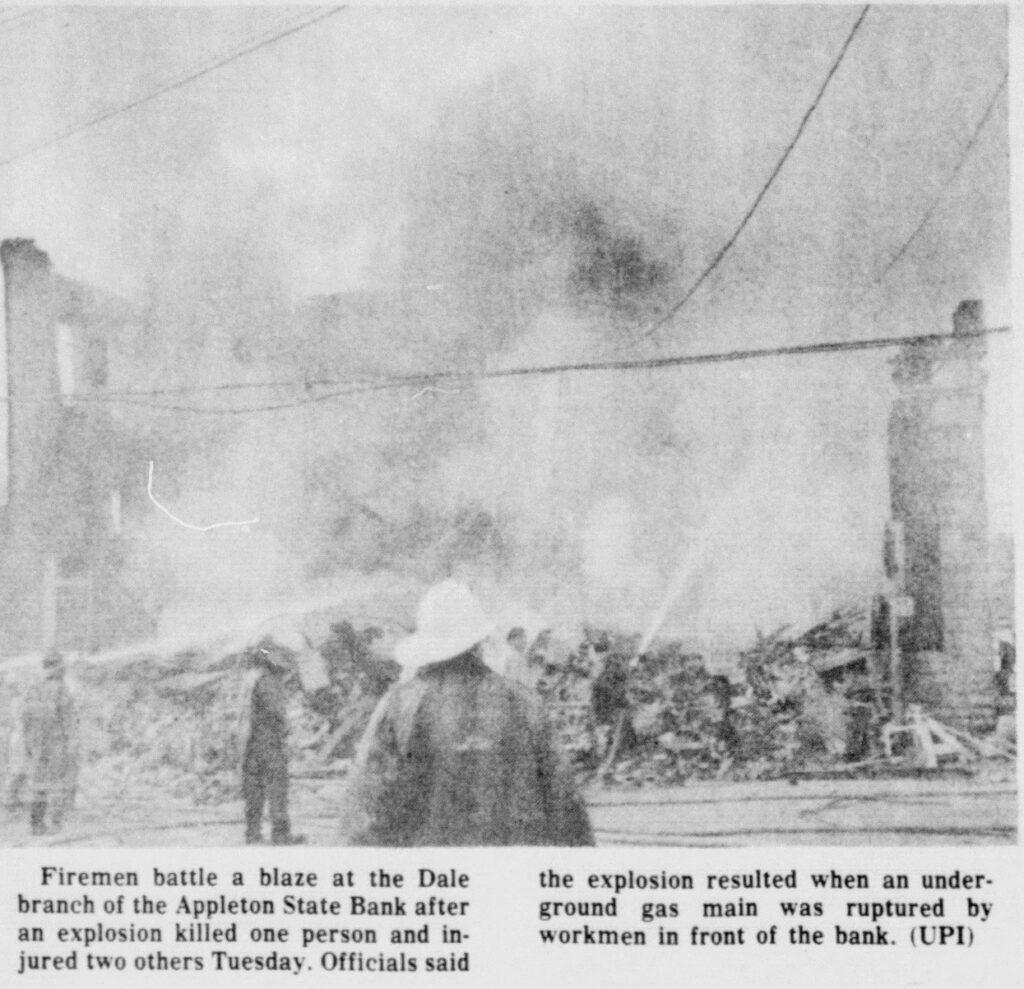
Lawrence Harvey Gorges, 47, had minor injuries from being tossed backwards by the blast. He told the press, “All at once the whole bank blew this way. The whole top and everything else went with it.” Somehow, none of the crewmen working outside the bank were injured. (Coincidentally, Gorges was a cousin of Harold Kloehn.)
The explosion destroyed the bank and the post office next door. Executive vice president Gilbert Relien had no immediate estimate of the damage or the amount of money burned up. Fortunately, all bank records were kept in the vault, which was bomb and fireproof. Postal service was temporarily run out of Dale’s town hall by postmaster Robert Krenke, and Appleton State Bank business out of a trailer, until both could have new buildings constructed. Bank customers were encouraged to go to other branches (Hortonville, Fremont, and Appleton) if possible.
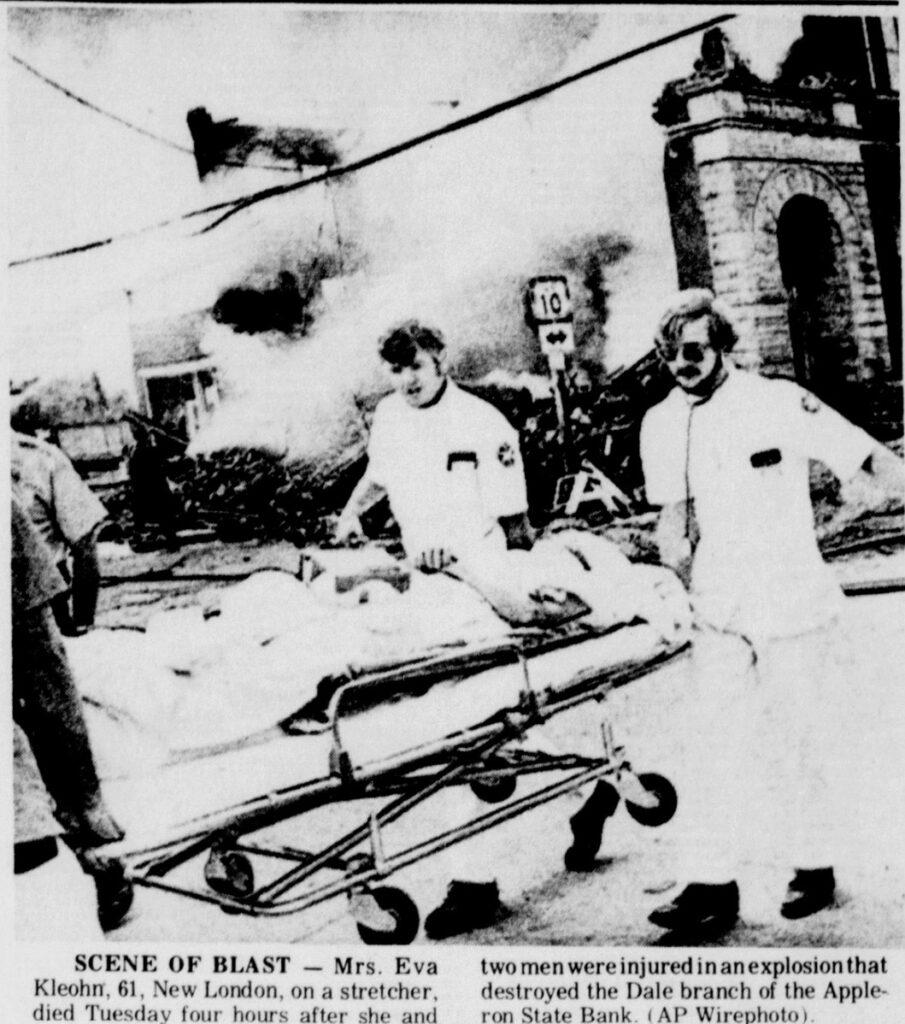
Already on September 4 (the day after), Valley Bank Corp vowed to beginning building a new Appleton State Bank immediately and have the building open by December.
On December 5, 2003, the primary route through Dale changed from US 10 to Wisconsin Highway 96, when new divided highway for US 10 between Greenville and Fremont was completed.
While outside the scope of this writing, St. Paul’s Lutheran has an EXCELLENT history of their church from 1859-present that is a key part of Dale history.
http://www.stpauldale.com/site/cpage.asp?sec_id=180019938&cpage_id=180100544