
July 31, 1909: Mary Ann Bieber was born in Philadelphia, Pennsylvania. She was baptized Catholic but was not raised in the Church. Her childhood was an unhappy one and she was repeatedly beaten by her father. Several of her later messages from Mary appear to allude to this abuse. Regarding one message, Mary Ann stated, “Mary said I was an unhappy child, always abused, misunderstood.”
The family moved to Kenosha, where Mary Ann received a fifth-grade education. Her mother, Elizabeth, was a Hungarian immigrant and joined the Kenosha Assembly of Spiritualists. Mary Ann reportedly participated in seances held at a “spirit cabin” in their basement. (Later rumors said Elizabeth was a “Magyar” in Hungary, a gypsy-like group that practiced witchcraft.)
Mary Ann moved to Philadelphia at age eighteen to live with aunt Anna Gallman and worked as a waitress. She fell in love with a Philadelphia man named Charles Worrell and had a child, James. She later claimed she received a marriage license from someone the couple believed to be a justice of the peace. However, they learned the man had not been a justice of the peace, and the couple separated. Mary Ann moved back to her family in Kenosha.
In 1934, Mary Ann answered an ad for a housekeeper placed by Godfred “Fred” VanHoof in The Wisconsin Farmer and Agriculturalist. Fred hired her and four months later they were married at a Catholic church in Kaukauna, though the priest did not think Mary Ann was a member. The VanHoofs would have seven children. Mary Ann’s mother, Elizabeth, moved in with them.
September 21, 1935, Fred auctioned off his 110-acre dairy farm at Kaukauna, including 26 cattle, 5 horses, and machinery. At the time of sale, he was still paying off a $7,300 mortgage. The VanHoofs moved with Elizabeth to Missouri where they worked as sharecroppers. Mary Ann disliked her husband’s family, who she called “those damn Catholic farmers,” and wanted to move as far as possible. The move failed, the family fell into debt and starvation (the children sometimes going weeks without solid food), before they finally purchased as 142-acre farm in Necedah – back in Wisconsin but far from Kaukauna. In fact, Mary Ann purchased the farm without Fred’s knowledge; his brother Henry who owned a creamery in Hurley got them out of debt, and it was expected Fred would take up work in Hurley. The Necedah farm was a scam – the dealer sold it cheap in the winter, and when spring came the VanHoof family found they had mostly purchased sand.
November 12, 1949: Mary Ann had a vision of a tall female figure entering her room and standing by her bed. Mary Ann was initially terrified, thinking the apparition might be a ghost, but Fred said it sounded like the Virgin Mary.
April 3, 1950: Fred’s sister Ardine VanHoof Green died. After the funeral, while drinking, the family discussed visions of the Virgin Mary that recently (November 1948) happened in the Philippines. Some suspect this was where Mary Ann picked up inspiration.
April 7, 1950: On Good Friday, Mary Ann saw a glowing crucifix in her room. She heard Mary’s voice, who told her to go to Fr Sigismund Lengowski with a request that everyone be directed to recite the rosary each evening at 8pm. Mary announced that she would appear again “where and when the flowers bloom, trees and grass are green.” The voice also said Fred’s niece, who was in Mendota State Hospital, was not mentally ill but possessed by the devil, and if the VanHoof family would treat Mary Ann better, she would be cured. (The niece never left the hospital.)
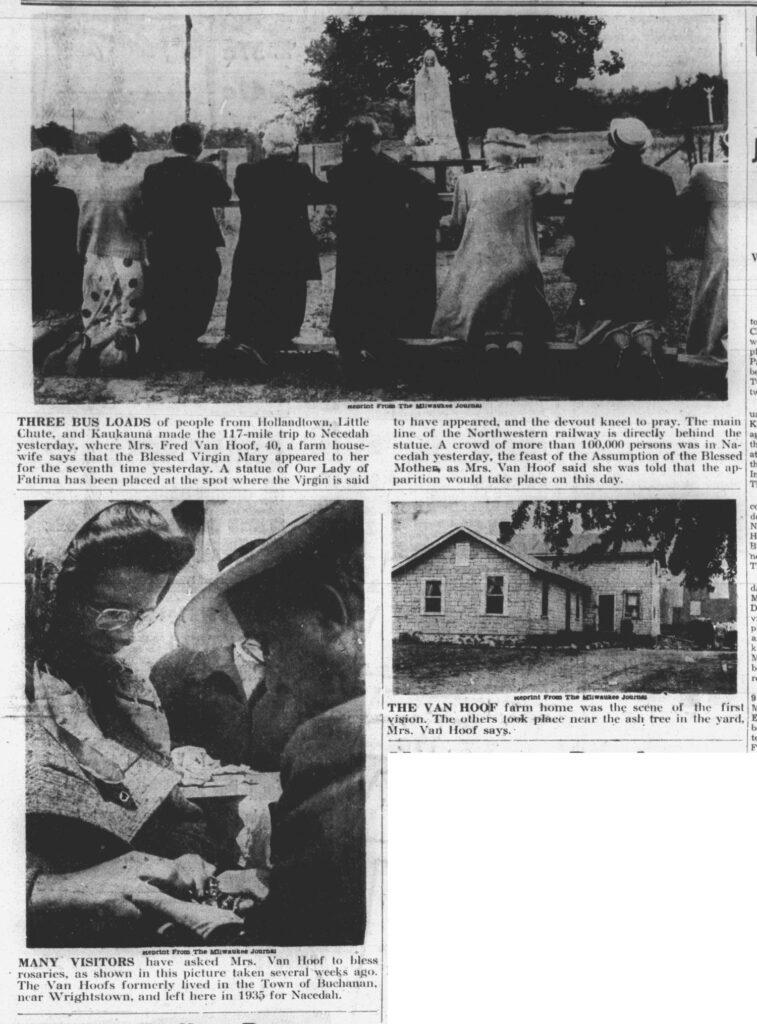
May 28, 1950: Mary Ann experienced her first vision of Mary. The site of the apparition, a group of four ash trees, became known as “The Sacred Spot.” Mary promised to return the next two days and on June 4 (Trinity Sunday), June 16 (Feast of the Sacred Heart), August 15 (Feast of the Assumption), and October 7 (Feast of the Rosary).
June 4, 1950: Twenty-eight people arrived at the Van Hoof farm to witness Mary Ann’s apparition. The house was described as “deplorable” and “filthy,” with no running water, and children who looked liek that had not bathed in months.
June 15, 1950: A team of priests visited Mary Ann’s home. They asked to see if her crucifix would glow in the dark. It did not. They expressed skepticism of her claims.
June 16, 1950: 1,500 people arrived at the VanHoof home to see an apparition. Some announced the apparition had cured them of disease. Six pilgrims gathered on the cellar door trying to peer into the house, causing it to collapse. Fr. Lengowski had guards placed at the home to keep out strangers. No one there claimed to see or hear anything besides Mary Ann, who said, “She came again, just like the other times. I knew she would. I saw the same light and she was there and she spoke to me.”
Henry Swan, president of the Necedah Chamber of Commerce, organized pilgrims into a group called “The Necedah Committee” to promote the apparitions. Benefactors built toilets and kneeling rails around The Sacred Spot as well as a statue of Our Lady of Fatima. A hand-carved cross from Italy was erected on a bluff overlooking Necedah. John Horning, a businessman from Milwaukee, purchased sixty acres north of the Van Hoof farm to provide parking. Before the next apparition, the Necedah Committee distributed 176,000 pieces of literature and Swan puchased radio ads.
Mary would relay Soviet invasion plans and the location of Soviet submarines. In one message, Van Hoof reported that “baby subs” were sailing up the St. Lawrence Seaway.
Henry Swan introduced Van Hoof to conspiracy theories that informed her messages. Van Hoof outlined “Satan’s Chain of Command,” a conspiracy in which a group a “grand masters” oversaw the “Learned Elders of Zion,” described as “Yids.” The Elders of Zion controlled Communism and Freemasonry, which they used to of create a one world government. Swan denied that his views were anti-Semitic and made a distinction between “true Jews,” whose blood was unsullied, and “Yids,” whose bloodlines and become “mongrelized.” One prophecy said white Christians would have to battle the black and yellow races, which the forces of evil would incite against them.
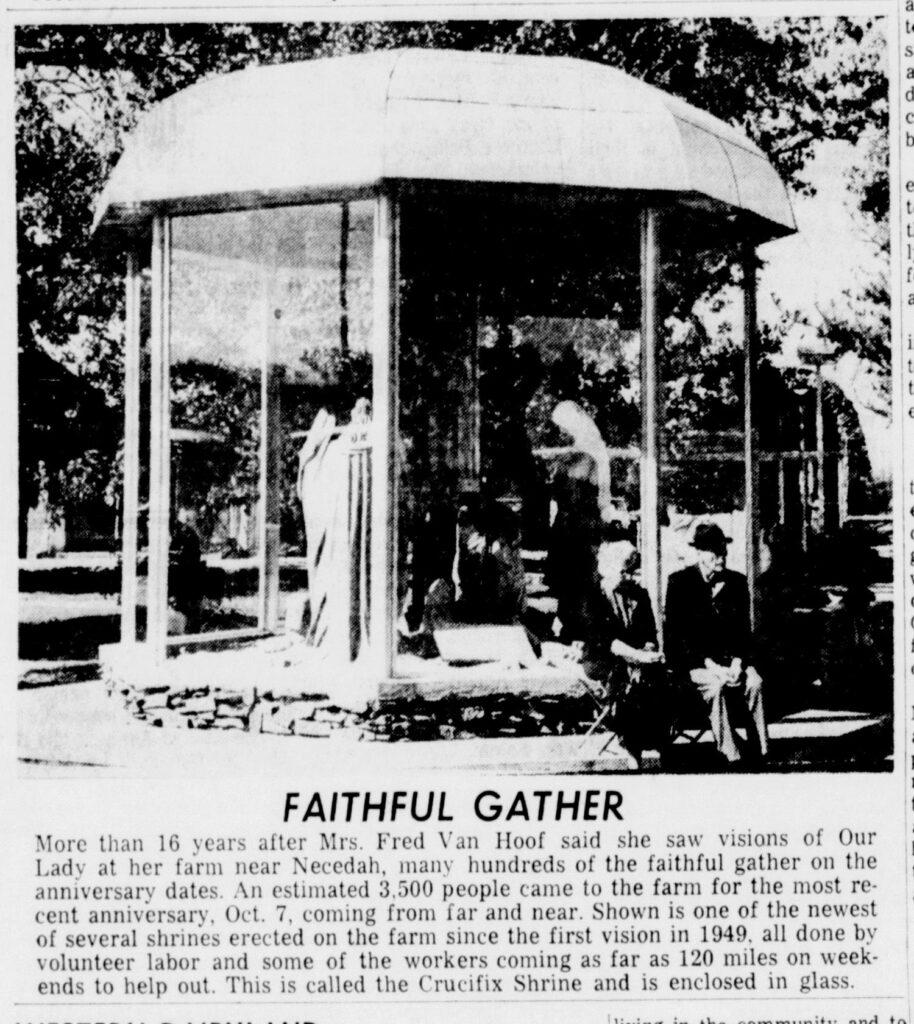
Mary related she had appeared to George Washington and told him that the new nation would withstand five great sieges: the American Revolution, the Civil War, World Wars I and II, and a fifth siege that would be the most terrible of all. Today, the Necedah shrine features a statue of Jesus flanked by George Washington and Abraham Lincoln.
Van Hoof could see beings she called “celestials” and some of these beings were the spirits of her departed friends and family. Some of her messages said the faithful will be transported to a paradise inside a hollow Earth where they will wait out the apocalypse. The shrine’s newsletter features a column called “Diamond Star Researcher;” that discussed a wide range of conspiracy theories, including speculation about planet X, coming pole-shifts, and secret military technology.
Through July 1950, Necedah made preparations for 10,000 people to visit the city. Appleton attorney Gustave Keller was in charge of publicity for a group called “Tell the People,” which was arranging food and lodging for travelers. Bishop John Patrick Treacy of LaCrosse released a statement around July 20 saying, “Investigation of alleged apparitions at Necedah has proceded as far as possible. For the present the church is not in a position to make any pronouncement. Printed accounts of the alleged apparition are entirely without authorization by the church. Much of the publicity connected with these events is spurious and regrettable. The numerous privately-circulated accounts are to be discredited as valueless.” (From 1950-1953, Fr. Claude Heithaus, a Jesuit archeologist, made a thorough background check on Mary Ann.)
August 9, 1950: Bishop Treacy issued a statement discouraging Catholics from attending the apparition on August 15. This does not seem to have worked. The Holy Cross Altar Society in Kaukauna, for example, had chartered three buses to take members there.
On August 15, 100,000 people gathered to see the apparition. Reporters arrived from Newsweek, Time, Life, and The New York Times. Mary Ann blessed the rosaries of those gathered.
August 17, 1950: Bishop John Grellinger of Green Bay spoke to the Knights of Columbus in Kaukauna and scolded them for their support of Mary Ann VanHoof. He reminded them, “Blessed are they that have not seen and have believed.” He continued, “Need Christ be crucified in every generation, that every generation might see his wounds, hear his words and witness signs and wonders?” Signs were for unbelievers, not the faithful. “An age which needs (signs) is one in which faith has grown weak, or one in which religious practices dear to God have fallen into disuse.” He said, “The ordinary means by which God shows His love for us are even more marvellous than the extraordinary.”(The reference is to St. Augustine declaring that God providing grain in the annual harvest is proof of His love more than the loaves and fishes that fed the 5,000.)
Further still, “Through the Savior’s coming we have received all the religions and moral principles God has willed us to know in this life. No new revelation will be given to man. The task confronting succeeding generations is that of penetrating more deeply, under the guidance of the infalliable Church, int othe riches of Christ’s teaching and of applying that teaching to the shifting panorama of our individual lives and of the social order… Through Christ’s continued presence on our altars we have an ordinary and more effective means of intimate union with God than any apparitions, however useful these may be to lend accent to the basic truths of faith.”
October 4, 1950: Father Lengowski was transferred to Wuerzburg, Wisconsin, seventy-five miles away from Necedah. His support for Van Hoof was likely a factor in his transfer.
October 7, 1950: 30,000 pilgrims arrived for Mary’s final announced appearance. Cardinal Samuel Stritch prohibited Chicago Catholics from attending, resulting in cancelled charter buses and a smaller crowd. Virgin Mary requested a large heart-shaped shrine to be built at the Sacred Spot.
November 1950: Van Hoof reported symptoms of stigmata. This was interpreted as penance for those who did not heed Mary’s message. Friends reported seeing her convulse and then collapse to the floor in a cruciform pose.
1951: The stigmata-like symptoms continued through Lent and Advent of 1951. Beginning in Advent, Van Hoof also announced that she could no longer eat food and was subsisting on a liquid diet. (the saintly phenomenon of inedia in which she could survive without food.)
May 28, 1951: Bishop Treacy sent Van Hoof a letter ordering her to take down the statues affiliated with her shrine and to cease disseminating literature about her visions. Van Hoof refused. Van Hoof replied to this order , “I am a free American citizen. This is my own property, and I’ll do as I wish.”
April 1952: Bishop Treacy asked Mary Ann to report to Marquette University for a ten-day medical exam. The exam coincided with Holy Week (April 7-12). The results of these tests convinced Church authorities Van Hoof’s experiences were not supernatural. Van Hoof’s head, arms, and hands were bandaged and sharp objects taken away. Under these conditions, her stigmata ceased. To test her claims of inedia, blood samples were taken and her salt levels were tested. Upon arriving at the hospital, her salt levels were normal suggesting that she was eating solid food. When she maintained a liquid diet during her hospital stay, she lost weight and her salt levels declined. A panel of three psychiatrists concluded that she suffered from “hysteria and repressed sexual anxiety” and her seizures were “long repressed sexual orgasms.” Fr Claude Heithaus discussed the results of the study with the press and described the convulsions associated with Van Hoof’s stigmata as a “disgusting performance”. Some of Van Hoof’s followers objected to the study’s findings and argued that supernatural phenomena cannot be studied using normal medical tests.
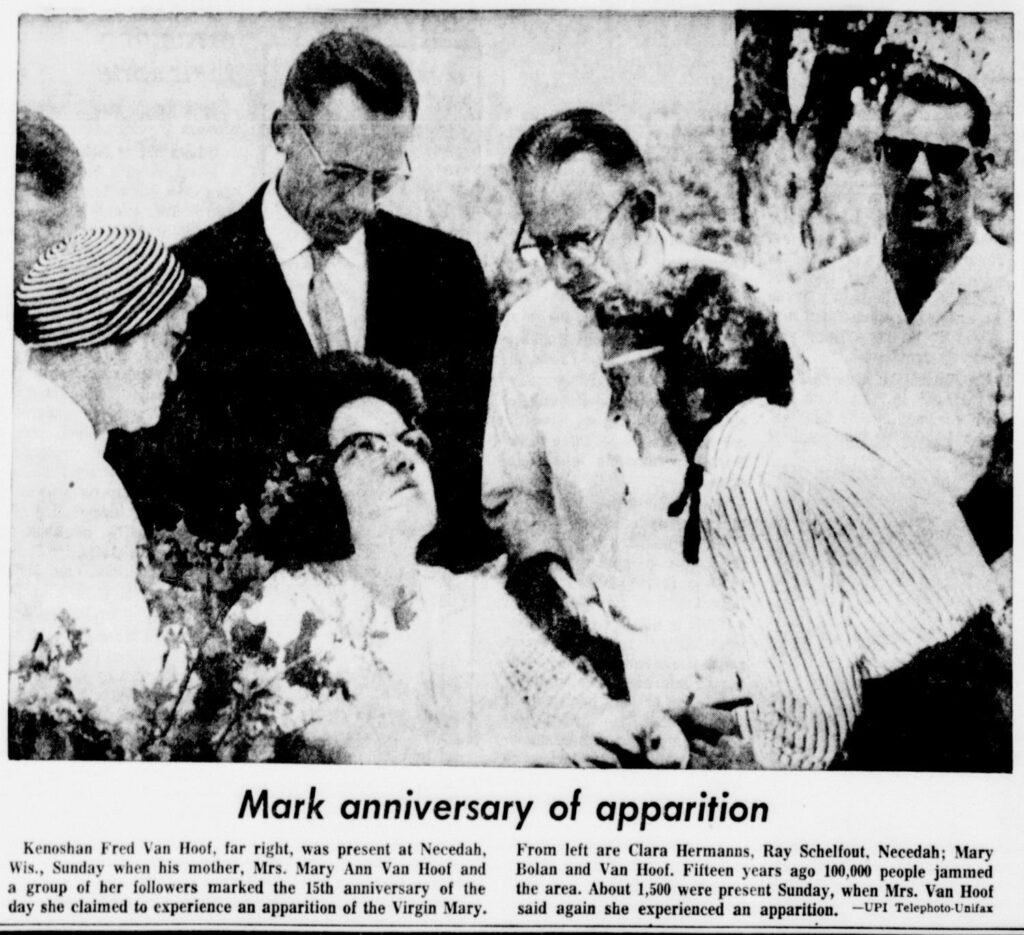
August 22, 1954: Van Hoof reported that Mary desired her two closest followers, Henry Swan and Clara Hermans, to write an account of their movement. Swan compiled the accounts..
June 1955: Bishop Treacy officially condemned the apparition at Necedah.
February 9, 1959: the VanHoof home burned down.
1959: Swan edited four volumes of material entitled My Work with Necedah published by Van Hoof’s followers through the corporation “For My God and My Country, Inc.” The president of this group was lumber dealer Ray Pritzel, who worked as Mary Ann’s bodyguard and claimed that communists wanted to assassinate her. The corporation owned the Roma Realty Company, the Jesus Mary Joseph Publishing Company of New Lisbon, and the Necedah Motel.
July 19, 1960: Fred VanHoof died of leukemia at age 67. The funeral was held at St. Francis Catholic Church in Necedah. He left behind his wife, seven children, four brothers in Little Chute and Kaukauna, and a sister (Sister Beatrice) of Milwaukee.
1963: A Catholic breakway group from Canada, the Apostles of Infinite Love, set up their US headquarters in a mansion in Necedah, inspired by Mary Ann. Three of their priests lived in the mansion. They followed “Pope Clement XV,” the former Fr. Michel Collin, who was defrocked. (This group still exists and is widely considered a cult.)
1964: Bishop Treacy died and was succeeded by Frederick W. Freking.
September 1969: Bishop Freking ordered a new investigation of the shrine.
1970: Bishop Freking reiterated Treacy’s condemnation of Van Hoof and her movement.
March 2, 1975: Bishop Freking placed Mary Ann and six followers under an interdict, denying them sacraments in their parish. (Interdiction is a step below excommunication – Mary Ann could repent.) Father James Barney, the new pastor of Saint Francis of Assisi Church, denied communion to anyone who would not renounce Van Hoof. During one mass, Father Barney reportedly asked “the loyal and obedient” Catholics to approach the altar and for Van Hoof’s supporters to leave.
September 1975: The Cap Times (Madison newspaper) did a thorough investigation and found many former supporters who provided lists of Mary Ann’s claims that were easily shown to be lies. On one occasion she told a group she was in the middle of a 10-day fast, when she had just publicly had both breakfast and lunch earlier that day. The local priest openly told the newspaper she was a fraud who catered to the “lunatic fringe” and would tell people she could see St. Michael riding around her yard on invisible horses to increase donations. They found the shrine members maintained a large arsenal of automatic weapons to prepare for a Russian invasion, and one member (Ron Shelfhout) was principal of the local middle school and encouraged teachers not to work there if their lessons did not agree with shrine policy. Against the wishes of teachers, all students were assigned Erica Carle’s “Hate Factory,” which one teacher )Don Hudson) publicly called “garbage” and not “real literature.” Shrine members dug their own wells because they feared city water would allow Russians to have mind control over them. There was strong political overlap between the shrine and the Youth Group of Covington, Kentucky, an offshoot of the John Birch Society.
May 1979: An announcement was made that that the Necedah shrine had been consecrated by Edward Stehlik, an archbishop of the North American Old Catholic Church, Ultrajectine.
January 1981: Stehlik quit the American National Catholic Church, returned to the Roman Catholic Church as a layman, and denounced the Necedah apparition as a hoax. Francis diBenedetto, a bishop of the Old Catholic Church, succeeded him as clerical leader of the shrine.
1982: Queen of the Holy Rosary School was founded near the shrine.
1983: diBenedetto also returned to the Roman Catholic Church and denounced the Necedah apparition as a hoax. Many shrine members defected with the loss of these bishops.
March 18, 1984: Mary Ann died. Hundreds of followers remained in Necedah and continued to promote the shrine.
Today, the shrine runs a private K-12 school, Queen of the Holy Rosary Shrine, and the Seven Sorrows of Our Sorrowful Mother Infants Home orphanage, known as “The Bay Farm.” The shrine relies heavily on volunteers to run services and continue construction of the Hall of Prayer. Little is known about the organization’s leadership; however, Theodore Bodoh is listed as the head of Seven Sorrows of Our Sorrowful Mother Infants Home orphanage in databases of non-profits.