
Herman F Abrams (1847-1932) of Oshkosh worked in the marble and monument industry. For a time, he owned the Oshkosh Marble and Granite Works.
In 1890, the Oshkosh Northwestern held a contest that whoever could sign up the most new customers on their paper route would win a bicycle. Herman’s sons Charles (7) and Edward (11) Abrams lived on Kansas Street (now South Main) between Ninth and Tenth Streets, and after much knocking, they won the prize.
Charles Abrams, a brakeman for the Chicago and North Western railroad, was engaged to Carrie Anna Seif, an ancestor of Kaukauna legend Troy Jackels, but for whatever reason they broke it off. He stayed in the train business for a while, at one point acting as a baggageman for a Conductor Kelley. His route was primarily between Antigo and Fond du Lac.
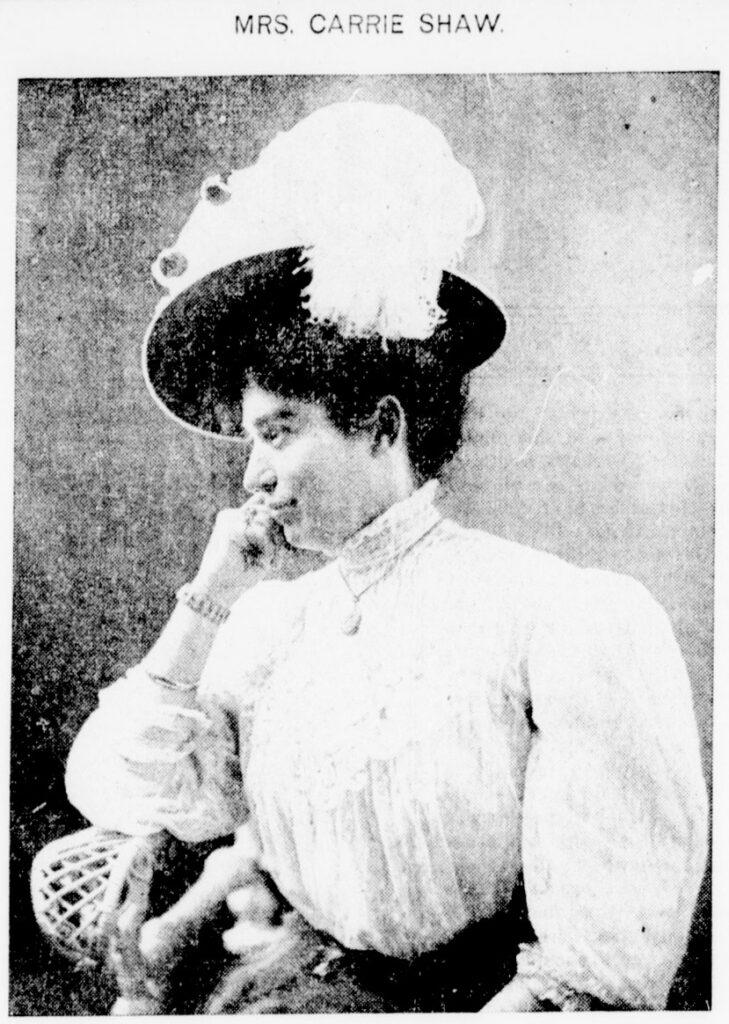
Carrie instead married another man, New London stock buyer John N. Shaw, but he passed away in October 1906, leaving her a young widow with a 3-year old son.
By 1908, still only 26 years old, Carrie took up residence at the Arlington Hotel in Hortonville, operated by Louis Jacquot. Jacquot was born in New York in 1839 and claimed to be descended from Parisian wine growers. He served in the Civil War, and spent time in both woodworking and the quarry business before taking over the hotel in the 1880s. Louis married Clara Wood. Carrie was best friends with Hattie E. Printup, Jacquot’s daughter (married to John A. Printup).
With Carrie again single, Charles Abrams allegedly began courting her again. He had moved up socially since the earlier days, now a partner with brother Edward H. Abrams in the Abrams Brothers’ Continental clothing store of New London (possibly at 201 South Pearl Street) and no longer working on the railroad. His business brought him frequently to Hortonville and Oshkosh. Charles apparently joined his brother as recently as March 1, 1908. Edward had previously worked in clothing sales in Wausau and married Nettie Gustavus, niece of ER Gustavus (whoever that is, newspaper thinks he’s important).
Abrams stopped by the hotel to see Carrie in May 1908 (May 20?) and soon they began to fight. Around 8:30pm, they went for a walk and were still having a spat, and it was believed they walked to keep from disturbing the other hotel guests.
The next morning, Carrie had not returned to the hotel and Clara Jacquot became worried. She was so concerned, in fact, that she allegedly called Abrams and asked about her, to which he replied, “That is none of your business.”
Search parties were organized and around 8:30am her cloak was found at the edge of a mill pond called the Dietzler pond. District attorney Francis J. Rooney, notified by telephone, ordered the pond to be searched. After a half hour, Carrie was found twelve feet down in the water and her body was brought to the Arlington Hotel. Signs of violence included a a cut upper lip, broken gold tooth and two cut fingers on her left hand. The first doctor to examine the body was Dr. Charles Reineck of Hortonville, who purposefully refused to discuss anything he saw with reporters. When asked if she had water in her lungs, he said, “I refuse to answer that; nor do I care to talk on the matter at all. I will tell all I know before the coroner’s jury.”
Hattie Printup said Carrie found Abrams’ attention to her “distasteful” and “she could not bear the sight of” him, perhaps was even afraid of him. According to Printup, the mothers of Abrams and Shaw (Katharine Moder Seif) wanted their children to marry, but Shaw “resented the wish.” One rumor said the two mothers were distantly related.
Based on the available evidence, Abrams was quickly arrested. He denied any involvement in Carrie’s death and said the two of them had parted at the depot. Abrams said, “My mother and Mrs. Shaw’s mother were great friends, and I had known Mrs. Shaw nearly all my life, although I had not seen her since November until I met her Tuesday in Hortonville. We corresponded with each other, although it can not be said that we were keeping company with each other. Yesterday I went to Hortonville to tack up some signs for our clothing business. About 4:45 I was leaving the livery near the Arlington Hotel and met Mrs. Shaw. She told me that she had something to tell me. We met another girl later in the evening. About 8:30 I called up Mrs. Shaw and asked her if I could see her. She said that she would be ready in a few minutes. I then met her and we walked to the brewery and talked about various things. I asked to meet her, as I wanted to know what it was she had to tell me. My mother died about two weeks ago and Mrs. Shaw talked to me about it. She expressed her sympathy several times. She talked about going West, and finally we walked toward the depot when a freight train came in. This was about 10:30 and a couple minutes later Mrs. Shaw concluded she would go up town again. This was the last I saw of her.”
An alternate theory was suicide. Relatives (not identified by name) told the press that Carrie’s “mental condition has been somewhat unsettled for some time” and “at one time it was proposed to have her examined as to her sanity.” She had threatened suicide “several times.”
The May 21 issue of the Oshkosh newspaper interviewed Mrs. Mayme Rhoades Mees, formerly of Hortonville and now of 373 Waugoo in Oshkosh. She knew Shaw “very well” and accepted the suicide theory. “I was not surprised to hear that a theory of suicide had been advanced as to Mrs. Shaw’s death,” she said. “I knew Carrie very well and had for several years, and I know she had so much misfortune she had at times made threats of suicide. Her father died about five years ago of cancer and left her about $5,000 and her husband left her more money and a good home, but she had many conditions in her life to more than counteract such advantages. She was married to a widower who had three children and these children brought much anxiety upon her. Then her husband died leaving her a little son, Harold. At that time she made the statement to me that her son was all she had to live for and that she would do away with herself but for him. She had previously sustained a stroke of paralysis and had another stroke after her husband’s death. For a time she was obliged to walk with crutches but later she almost fully recovered her strength. But she met with another accident. While the roller skating craze was at its height at Hortonville, Mrs. Shaw was practicing one day in her kitchen and she fell and broke both legs.” Mees said on one occasion Shaw had “prepared Paris green” and was going to kill herself but a girl friend talked her out of it. Another person (unnamed) said Shaw burned herself on a stove during an epileptic fit.
Judge TH Ryan postponed his preliminary examination until May 29 to give officers time to investigate.
Justice Sanborn put together a coroner’s jury who looked over the remains and talked to a few witnesses, and then adjourned for the weekend while Abrams remained in jail. A medical examination of Shaw indicated she had very little water in her lungs and stomach, usually indicating that she stopped breathing before she entered the pond. However, both Dr. Charles Reineck and Dr. ME Rideout said they believed she was alive when she entered the water and suspected suicide.
Witness Laura Klein saw Carrie Shaw and a man walk by her house, one block from the depot, around 10pm. She believed it was Abrams. Mrs. Emma Prine, who lived with Shaw, testified that Shaw had told her she was afraid of Abrams. The reason was because Shaw was “keeping company” with 20-year-old Harold Printup, son of Shaw’s closest friend. How to interpret this is unclear. Officer Thomas Lunn said he did not see Abrams board the train at 10:40pm or at midnight, despite people claiming to see him in New London that same evening.
Katie Seif, Carrie Shaw’s mother, added, “She and Charley had a falling out shortly after Christmas. A few weeks ago another young man began calling at the house and several nights he remained until 11 or 12. I told Carrie I could not stand for that, as I could not sleep when they were up so late, and she had better go to the hotel or some other boarding place. She left on April 16 and we had not spoken since.”
By May 25, District Attorney Rooney found himself in a tricky spot. The cause of death was, in his opinion, most likely murder, but a number of witnesses had come forward saying Abrams and Shaw were seen at the depot mere minutes before the 11:00 train took Abrams out of town. If he was the killer, he would have to be unbelievably fast. Three men (Joseph Remmel, Daniel Kelley and Fred Krause) also saw Abrams walk by the Remmel saloon in New London around 11:30, indicating he must gave taken the 10:40 train. This left only one possibility: murder by a different, unknown person.
News reports said Hortonville had recently seen “a number of robberies and a safe-blowing affair” so it was entirely possible an unescorted woman walking in the dark could be attacked by a “ruffian.”
Second half of June 1908, Carrie Shaw’s will entered probate. Her estate was valued at $8,000. Heirs were her son Harold, mother Kate Seif, brothers Edward and Frank Seif, and sister Mary Leppla.
Harold Wayne Shaw, already without a father and only five years old when his mother was killed, appears to have spent his life in New London. He married a woman named Lyle Jennings, also of New London, and passed away there in 1973.
Charles Abrams, cleared of suspicion, went back to his life at the clothing store. He married ?? and lived happily in retirement in New London. Charles passed away in 1972, not long before Carrie Shaw’s son.
His nephew was an early resident of Hawaii.