
(Trying to find contemporary sources for this was hard, so I’m relying heavily on newspaper articles from 1962 and much more recent. Earlier sources were used when possible. I cannot vouch for the accuracy, but made corrections to any obvious errors. The accounts are not always consistent on the timeline. Spellings were wildly inconsistent, and as always these are merely notes and not intended as a fully-edited essay.)
John Baptiste Evearts (Evereats, other spellings) started out as a typical tavern proprietor with “a thriving business” serving the working men of Green Bay. He had a wife he loved, bills to pay, and dreams no grander than any other immigrant trying to make it in Wisconsin’s rough-and-tumble frontier economy. His future seemed predictable: pour drinks, make a living, grow old behind the bar.
Then his wife got sick, and everything changed. In the late 1870s, Mrs. Evearts fell desperately ill—so ill that doctors examined her, shook their heads, and essentially sent John home to prepare for the worst. Medical science, such as it was on the Wisconsin frontier, had nothing more to offer.
In his desperation, he did something that would have scandalized his Catholic neighbors in the Belgian settlement: he consulted a spiritualist healer. Spiritualism—the belief that the living could communicate with the dead and that spiritual forces could heal the body—was sweeping through America. It was controversial, often dismissed as fraud, and deeply opposed by the Catholic Church.
The spiritualist medium went to work. And incredibly, miraculously, Mrs. Evearts recovered. Not only did she survive—she thrived. When John came to pay for the services, grateful and amazed, the medium looked at him with penetrating eyes and said something that would change Wisconsin history:
“You, too, have the gift of healing. And you also have the gift of prophecy. If you will stop your business of selling rum and permit the spirits to work through you, you will become a great speaker, bringing messages of power to a people hungering for light!”
According to the Belgian American Club newsletter, “Greatly impressed about what the medium told him, and his wife’s recovery, John sold his business and began developing his powers as a medium.”
He began holding séances in private homes around 1880, particularly in the home of his “brother-in-law” Joseph G. Dalemont, a notable politician in the town of Gardner. (I was not able to find a family link between Evearts and Dalemont.) People came, curious and desperate. The spiritualists offered something the established churches couldn’t: direct, personal contact with departed loved ones. No intermediaries, no priests, no elaborate theology. Just you and the spirit world, with a medium to help translate. “Soon he had a modest following,” according to historical records.
In 1885, Evearts came to Door County to visit Belgian relatives living in Gardner, near Brussels. The Belgian settlement in Door County was only about thirty years old at that point—a community of Catholic immigrants who had fled poverty in Europe to carve farms out of Wisconsin wilderness.
These were deeply religious people. They had survived cholera epidemics that killed entire families. They had endured the apocalyptic forest fire of 1871 that burned their homes, their barns, their livestock, and left nothing but charred stumps for miles. They had built small log churches where visiting priests celebrated Mass.
When John Evearts arrived and began holding séances, word spread quickly through the tight-knit Belgian community. This did not sit well with Reverend Stevnard (also spelled Stevenart and Stevenor), the Catholic priest at St. John the Baptist Church in Gardner.
Rev. Stevnard had arrived from Canada just that winter to serve the Belgian communities of Gardner, Union, and Brussels. He was exactly what the settlers needed: French-speaking, orthodox, and willing to ride circuit through primitive roads to bring the sacraments to scattered families. He was also utterly opposed to spiritualism, which the Catholic Church condemned.
When Rev. Stevnard heard this medium was holding séances and attracting followers from his own parishes, he made a declaration that the Door County Advocate described as “a moment of righteous but unguarded zeal”:
He proclaimed publicly that no medium could communicate with the dead if he, a priest, forbade it. It was a bold claim—essentially saying that his priestly authority could overpower whatever spiritual forces Evearts was supposedly channeling. In the Catholic worldview, the priest was God’s representative on Earth. Spiritualism was trickery; a priest’s blessing should dispel it like smoke.
Harris Duchateau, a Green Bay follower of Evearts, saw an opportunity. He put up $1,000—the equivalent of roughly $30,000 today—and challenged the priest to prove his claim.
The terms were simple: Evearts would conduct a séance. Rev. Stevnard would be present and would attempt to prevent communication with the spirits using his priestly authority. If the priest succeeded, Duchateau would pay him $1,000. If Evearts successfully communicated with the spirit world despite the priest’s presence, the bet would stand unclaimed—and the priest’s authority would be undermined.
Rev. Stevnard accepted. The date was set: June 22, 1885, at ten o’clock in the morning. The location: a private home in Gardner, chosen because the homeowner was considered impartial. (One source says the home was that of E. Dandois, a spiritualist.)
On that bright summer morning, several hundred people assembled. These weren’t just curious onlookers. According to newspaper accounts, “Most were Father Stevnard’s parishioners”—the Belgian Catholic families the priest had been shepherding, people who had walked miles through the woods to witness this extraordinary confrontation.
Ten o’clock came and went. No priest. The crowd grew restless. John B. Evearts waited calmly. He had shown up on time, ready to demonstrate his abilities. But the star of the show—the man who had accepted the wager—was nowhere to be seen. Finally, someone hitched up a horse and buggy and rode off to fetch Rev. Stevnard. (One newspaper account says Duchateau declined to sign the paperwork guaranteeing the $1,000 and this was the cause of the cancellation, but a follow-up report denied this.)
According to the July 7, 1885 newspaper account: “When the priest finally did put in an appearance he positively declined to perform that which he had previously boasted of; but on the contrary denounced and berated those present in unmeasured terms.” The reaction was swift and devastating.
“Some of the parishioners present were so turned off by the priest’s performance that about forty of whom forthwith renounced all allegiance to the church and joined the ranks of the Spiritualists.“
These were people who had been baptized Catholic in Belgium, who had brought their faith across the ocean, who had buried their children in hastily dug graves during the cholera epidemic while priests administered last rites. They had built log churches with their own hands. They had walked miles through wilderness to attend Mass. And in one morning, their priest’s failure to stand by his word—his refusal to even attempt what he had so confidently proclaimed he could do—shattered their loyalty.
For three years, the new spiritualists met in private homes. They held séances, communicated with departed loved ones, practiced spiritual healing, and built a community based on direct experience rather than institutional authority.
Then, in 1888, they did something remarkable: they built a church—the White Star Psychic Science Church, located on County C in Gardner. Land was donated and funds were raised by 35 families. The White Star Spiritualist Church “thrived from its inception, and by 1917 it had 300 members,” according to the Belgian American Club records.
It developed a theology (Spiritualism’s Nine Declarations of Principle), established a cemetery, ordained its own ministers, and became a permanent part of Door County’s religious landscape.
Still under Evereats leadership in 1895, seven children were baptized that year, including Lucy DeBroux Vetter (who was later a correspondent for the Door County Advocate).
One of the church’s members, Alexander Dewarzeger, was noticed as a child to have “supernatural powers” and could communicate with “the unseen world.” Dewarzeger succeeded Evrarts in the early 1900s following Everts’ death. He is credited with using his healing powers to save August Balza after four of Balza’s children died of diphtheria within a few hours of each other. (Balza died in 1910.) Dewarzeger married Rose DeBroux and she also helped lead the church until her death on December 10, 1951. Other Gardner mediums blessed with psychic powers included several members of the Dewarzeger and Delveaux families.
From 1951 through 1957, William Twele was in charge. After that, his widow Clara Twele was in charge at least through 1975. By 1975, the congregation had shrunk to around 40 members. Instead of the traditional (Christian) religious painting or cross usually found, at the right of the altar there hangs a portrait of an unsmiling, bearded man wearing a turn-of-the-century celluloid collar: John B. Everts.
Clara’s story is an interesting one. Ill health prevented her mother from doing heavy housework so a young Danish girl was hired. It was the family’s custom to sit around her mother’s bed in the evening and “talk with God” in the company of their Danish friend. Clara, her siblings and the hired girl would join hands and sing until a voice would speak to them. “Mother also had the gift,” Clara smiles, “but she couldn’t understand Danish. Messages in that language had to be interpreted.” One day her mother became ill and as her children prayed for her recovery, a voice addressed them in Danish giving explicit directions which only the hired girl could understand. “Take the little girl Clara with you,” it ordered.“Take her by the hand and go to a hill. She will tell you what blue berries to pick; pick only those and prepare a tea for the lady to drink. The lady will get better.” The rescue mission immediately set off for a nearby hill and Clara selected a patch of juniper berries. Her mother recovered.
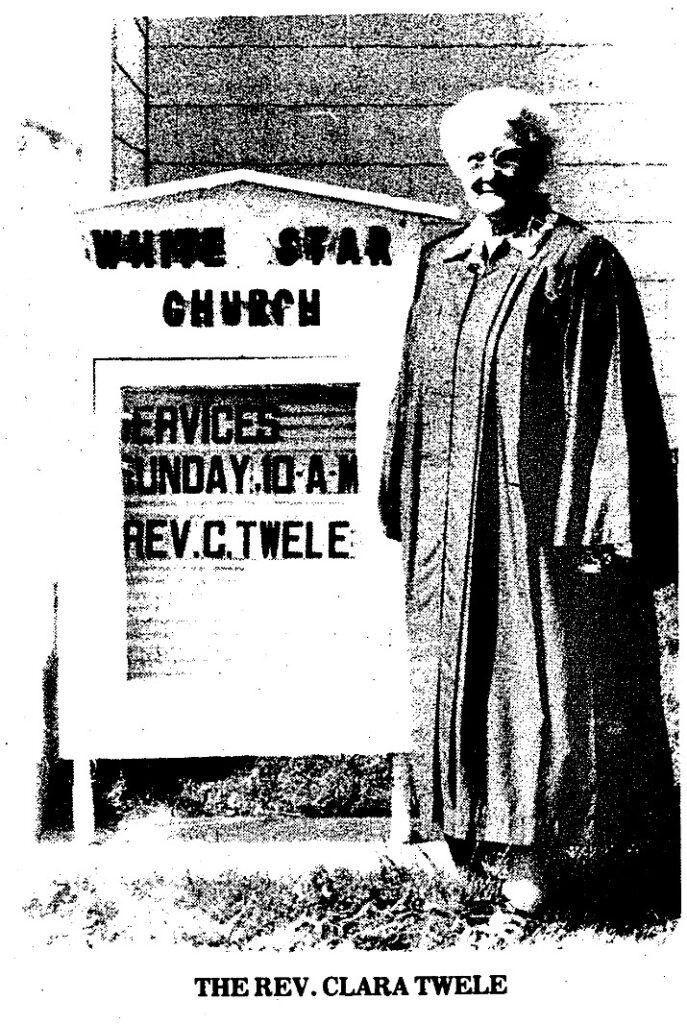
After that, Clara went into nursing, but was bothered that she would receive visions whenever someone was about to die. One day in 1933 she was visited by her brother Arthur, who had died in a plane crash in 1929, and he taught her how to “open the door” to the other side. She made her way to Door County where she joined the church. Once pastor, she was assisted by recording secretary Mrs. Zephyrs LaViolette, who was the niece of Constantine Delveaux – the first baby baptized by the church.
1975: “Although her three predecessors made their earthly departures many years ago they still regularly attend services. Rev. Twele says Everts rarely misses a Sunday and, in fact, communicated at; some length with her,the date this visitor attended church. Old habits apparently died hard and Everts still can’t get used to sitting in a pew. He occupies a chair under his portrait at the front of the church. Rose and Alexander come and go during the 90-minute-service but Everts usually remains to the end.”
Clara has this message for skeptics: “It is just as foolish for people to deny that the dead can be seen and heard as it is for the blind to claim the sun doesn’t shine because they have never seen it. Or for the deaf to reject the fact birds sing. because they. have never heard them.”
It is “the only Spiritualist church remaining in Northeast Wisconsin and one of the few remaining Psychic Science Churches in the state of Wisconsin,” according to historical records.
First Spiritualist Cemetery, also called White Star Cemetery, contains the graves of dozens of Belgian American families who followed Evearts into the movement. These weren’t the family names you’d expect to find in a spiritualist cemetery. They were Belgian Catholic names. Before the cemetery was established, spiritualist believers were buried in a corner of the George Delveaux farm at the corner of Brussels and Cemetery road in Gardner Township. There are no markers of any kind at this spot although 18 persons are said to have been buried there.