
Henry Ferdinand Quade married Mathilda “Tillie” Buelow. They had seven children.
November 1897, Henry appears in city records bidding on the job of putting sidewalks in on Taylor Street. An article in 1899 has him as an employee at the Quinnesec paper mill (which I believe was in Niaraga, Marinette County).
August 26, 1900: The family had been with about 30 others along the river for a fish fry, in the general area of Lindauer and Rhode’s brickyard in Kaukauna, but found a rowboat near the brickyard and decided to give it a try. The family was bigger than the boat, so the 14-year old daughter (Annie) stayed on shore to watch a 3-year old girl (or boy in a different story) and 3-month old boy, Henry Junior. (The brickyard was roughly where you would be today if you take Augustine Street north all the way to the dead end.)
Mother Mathilda, and sons Harold, William and Frederick (ages 6, 8, 10) were drowned in the Fox River just below the first lock in Kaukauna at an area estimated to be 12-15 feet deep. Also on the boat were Henry and another child, Elsie, with everyone going in the water when the boat tipped. They had been switching seats to change out who would row. Henry was able to hang on to the capsized boat, and Elsie caught her father with what the newspaper called “death grip energy.”
Picnic’ers on shore saw the capsized boat and thought nothing of it at first, thinking perhaps the family was swimming, but then realized the trouble and through teamwork brought them to shore. Mathilda Quade, though dead, was said to have her hands firmly grasped on the anchor rope. They untangled her from fishing line and tried to resuscitate her, but it was clear she was beyond saving.
Two of the sons were found the next day, dead but clasped in each other’s arms. Another day would go by before the third son (Freddie) bobbed to the surface. His father found him near the brickyard – not far from where the boat capsized. A coroner’s inquest was held and the result was “accidental drowning.”
Henry was re-married, to Christine Ringer of Green Bay, in October 1902, resulting in two more children.
Part Two
Henry Alwin Quade, 1900-1995, son of Henry Ferdinand Quade, and Henrietta Weil, 1899-1970 of Manila, Philippines were married in Shanghai, China at the consulate (No. 6 Young Allen Terrace – apparently a Protestant mission) on February 1, 1923 by Methodist Rev. Alvin Pierson Parker in the presence of consul Allman. Her name suggests a German origin, but she was a citizen of the Philippines and born at Manila. (Rev. Parker’s diaries are held by Stanford University, and may mention Quade in there – future research for someone.)
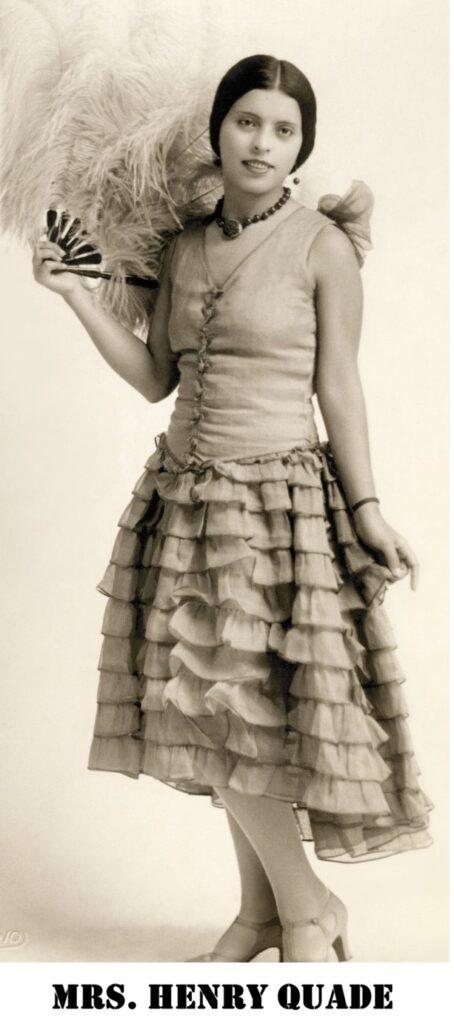
How Quade met Henrietta is not known – her background is a complete mystery. However, we know from the 1920 census that Henry was stationed on the USS Wilmington, which was based out of Shanghai. And we have a ship record having him traveling to the Philippines in January 1922.
GM established their first local assembly operation in Tanjung Priok in February 1927, as “KN Gaya Motor.” The location was suitable as there was ample timber nearby, a necessity for car body manufacture at the time. In 1930, the company was renamed “N.V. General Motors Java Handel Maatschappij.” Cars from their Jakarta factory were exported all across the region.
Henry Quade moved to Batavia in 1934 to work for GM. In january 1935, he was in New Zealand while on his way from the US to Indonesia, and informed them there could be a good market for Australian cars in Indonesia – the ones made locally were of lower-cost materials and the higher-quality Australian models would fil la niche.
July 8, 1935, local (Dutch) news reported, “The director of the Dutch East Indies automobile factory in Tandjong Priok, N.V. General Motors Java H. Mij., Mr. G.C. Seers,will be leaving for Europe on July 10th, which will also include a business trip to New York. During Mr. Seers’ absence, H. A. Quade, the General Sales Manager who has just returned from leave, will act as acting director.”
Fortunately Henrietta left in November, 1941, but Henry became a “guest” of the Japanese in Soekimiskin Prison.
After having been requisitioned by the Dutch government in 1941, on March 9, 1942 all machines and equipment was destroyed to avoid it falling into the hands of the approaching Japanese. Two weeks later the Japanese occupied the plant and interred all foreigners; on December 31, GM wrote off the entire enterprise. The plant was taken over by Toyota, and was used to assemble trucks for the military.
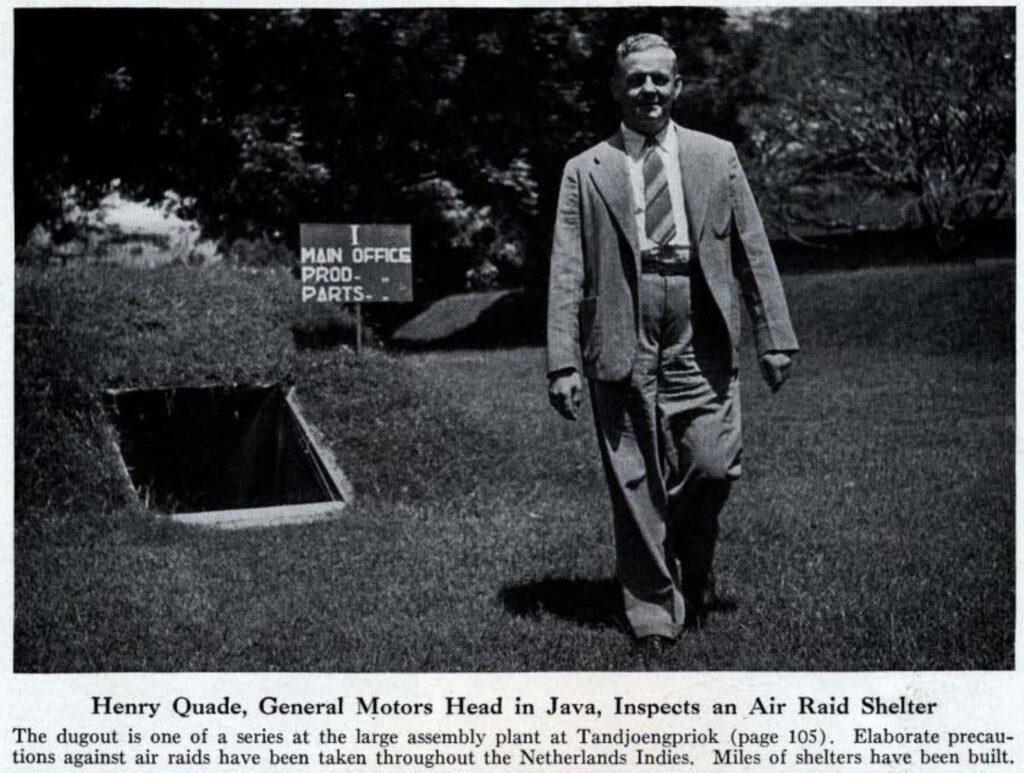
WWII imprisoned in Java. He built the Air Raid shelters in Java. He wouldn’t leave until all the General Motors workers got out of the country. Then there were no more planes to take him.
While imprisoned, he was visited by Mrs. Jane Zumsteg. She later said prison doctor R. Tj. Pratignjo told her, “I shall be the first one to cut the throat of every American entering this country.”
November 25, 1945, Quade was flown by Army plane #C54-7199 to Hamilton Field in San Francisco. His final destination was listed as GM Overseas Division in New York City. His last permanent residence was listed as #4 Burgomeester, Bisschopplein, Batavia, Java. (Bisschopplein was the former name of Taman Suropati, a park and area in Batavia, which is the historical name for modern-day Jakarta, Indonesia.)
1945-1949, Indonesia fought for independence from the Dutch. This does not seem to have halted the manufacture of automobiles.
In 1946, General Motors Overseas Operations established a Batavia Branch (later renamed “Djakarta Branch”) to continue the pre-war activities, building nearly 20,000 vehicles in the next six years. Quade wrote about his experience during the war and it appeared in the Milwaukee Journal on September 1, 1946. To keep the flow of this summary going, it is attached to the end.
According to GM reports, total automobile registrations in Japan in 1951 stood at just 29,043, and annual increases were estimated at just 6,000 cars. H. B. Philips and H. A. Quade, “Report on Visit to Japan, January 24-February 21, 1952,” Overseas Policy Group, Corporate Executive Commit-
tee, GM, GM Corporate Records. In addition, Ford and GM also foresaw important opportunities to expand in the domestic U.S. market, in Europe, and in Australia. See, for example, various internal reports of the Overseas Policy Group, GM Corporate Records.
By 1953, GM activities in Indonesia had mostly ended as Sukarno’s pro-Chinese government took power. At a meeting of the shareholders on April 14, 1956, it was decided to place the Company (N.V. General Motors Handel Mij. and the Djakarta Branch) in liquidation. The Branch Manager’s residence, including furniture and fixtures, and the six company houses, all of the value of which were carried on the books of GM Java, were sold to the local United States Embassy.
Eventually they moved to and spent the rest of their lives in New York City.
January 1956, Henry “gave away” Rita Han Tiam Nio of New York to Sumner Howard of Westport, Connecticut. Mrs. Quade was maid of honor. Rita’s parents were in Indonesia while Sumner’s parents were from Flint, Michigan.
Died September 1995 (allegedly), but no record of death has been found yet.
As one of three executors of Quade’s estate, banker Silas Mountsier was allowed to donate $500,000 to a worthy cause of his choice. He chose Allegheny College and used these funds to help physically transform the college’s campus into the beautiful place it is today by developing Quade Walk, a series of paths that run through the middle of Allegheny’s campus. Silas’ personal compensation for being one of the executors of Quade’s estate was an additional $500,000, which he promptly donated to Allegheny College to commission public sculptures to further beautify the campus.
**
Henry Quade’s First Person Account of World War II
I suppose I could have got out of Java before the Japs arrived, but my office people – British and Dutch – had stuck with me, and I didn’t like running out on them.
When the Japs came I was sitting at my desk writing. For four weeks they didn’t bother me, then, bingo, they took me and some others and threw us into solitary confinement.
We were in a Dutch civilian prison. My 4.5 by 9.5-foot cell got a little sun in the afternoon, but we were 3,000 feet up and it was awfully cold. Our cell doors were solid, with slits about six by two inches and a flap outside. We could wiggle the covers and see out into the corridor, but we weren’t allowed to talk. If we were caught doing it, the Jap guards beat hell out of us.
They used to question people in the middle of the night at a table outside my door. When they questioned me, I tried to be very nonchalant, and didn’t show them I hated their guts.
The Jap interrogator asked me how much I had in the bank, and I told him because I knew that he had already checked up. Then he asked me how much stock I had. „My wife has it,“ I said. This sounded good to him. He thought my wife was in the women’s prison camp nearby. I could see him smiling and figuring how he’d get his hands on the loot.
„Where is your wife?“ he asked. I said, „New York,“ and burst out laughing when his face fell. They can’t bear to be laughed at and they took it out on me plenty. Used a bamboo.
During the first week or so, I lay in my bunk and thought of all the tortures I’d inflict on the Japs if I had a chance. But I found this hate was wearing me down. It kept me from sleeping, so I began deliberately to push these thoughts out of my head. I figured on being in for two years, and knew I’d have to do something to keep from going crazy. (As it turned out, I was optimistic, I didn’t get out for three and half years.)
I got to thinking about a boat. The thing most unlike being in a cell would be cruising around on a boat, where you were the boss and could go anywhere you felt like.
The Tangjong Priok yacht basin was right next to our plant in Java. Seagoing yachts and cruisers were always tying up there and I’d often thought of building one for myself. Up till then, I’d nver had the time. This was my chance.
Of course, we weren’t allowed paper or pencil or books. We were just alone with our thoughts. In my mind, I first went over different boats I had liked, and I recalled constructio ndetails that ordinarily I’d never have thought of again.
I finally settled on a 45-foot combination sai land diesel, with two masts. I was going to have Irish linen sails, which last practically forever, and stainless steel cables. For purposes of planning, I used Javanese teak – because it is virtually the same weight as water. Thus I could carry in my mind the growing weight of the hull as I built my boat.
I couldn’t carry too many fractions in my head, so I simplified matters by using one-inch planking and two-by-four ribs. Knowledge of my own company’s motors made it easy to estimate the weight of my diesel engine.
It’s pretty hard to remember figures when you’re hungry. We always were. I had to go over and over my basic measuements. Mostly, I worked on the boat at night. It was bitterly cold, and my cotton blanket was about as thick as a tablecloth. I’d pull it up over my head to keep out the mosquitos and then review my figures and work out new ones until I fell asleep from exhaustion.
Finally I got the keel laid and the planking on, ran up the masts and figured the total displacement. After that, it was comparatively easy to install the engine and an auxiliary motor for the generator.
I designed the galley, with an oil-burning stove, very compact, and kitchen utensils that would clamp on to the range. I decided to divide my stores into lockers as they would not shift. And, believe me, I was going to have some swell grub – cases of hams and chicken, and canned sausages and bacon and fruits and jellies.
The table just outside my cell was used for distributing the food. And when I was so hungry I could hardly stand up, I’d see the guard fishing out the tiny pieces of meat from our soup. I figured I got less than a quarter-pound of meat a month.
Anyway, down in my galley, I was always going to have a pot of Dutch pea soup – the kind that has lots of sausage floating around in it. And i was going to be able to go down and make myself a fried spam-and-egg sandwich at night. I hear the Gis don’t think too well of spam, but I used to dream about it. While doing hard mental labor on the boat, I’d often find myself making excuses to knock off and make a hot sandwich.
When I got the water and fuel tanks full, I began figuring space outside the lockers and sacks of rice and other food for the native crew I planned to have. I thought i would salt fish for them and dry it on the masts. Then I realized how crazy that was – we could just fish it up when we wanted it.
Then came the big day when I visualized all my stores sorted out on deck. But somewhere my calculating had gone wrong. A year’s supply seemed absolutely essential, and I hadn’t allowed enough space for it.
There was nothing to do but start over again on plans for a bigger boat. A 65-footer was doubtful, but a 90-footer would surely do it. I even toyed with the idea of a 120-footer, but that would have tied up a lot of money. I had to consider costs of wharfage, crew, insurance and harbor fees. I decided on the 90-foot schooner. I’d keep the 45-footer anyway and use it in Java for offshore sailing.
So I went to work on the bigger job, and I got it nearly done before I was taken out of solitary and put i na prison camp. There were several ship’s officers in the camp, and we talked my boat over from end to end.
An Australian prisoner had once actually built such a boat. I had wanted a wide stern on mine to make room for a big cabin, but he insisted that a double-ender would be more stable in following seas. We argued a lot about that, but I finally gave in.
Another officer instructed me in elementary navigation. When the Japs weren’t looking, he’d draw diagrams with charcoal o na concrete manhole cover in the prison yard. He taught me rules of the road, buoyage systems and how to use tide tables. I took a long time deciding on a name for my boat. I finally settled on Orang Timor Laost. That’s Malay for „Man of the Eastern Seas.“
I am not much of a drinking man, but I wanted liquor on board for guests. On the forward bulkhead of the main cabin, I was going to have a sliding panel, and inside a cask of sherry I’d pick up in Spain, sort port from Portugal, good brandy from France.
That about finished it. And I think my dream boat is what kept me going. I used to figure out mileages and costs, but that was just relaxation. I was going to take a summer cruise around the Mediterranean and then into the Black Sea.
Of course, I have never really built my boat. When I go back to Java, I probably will. I’ve always thought that when I retired I’d want to take a five-year cruise on just such a boat. But I’m not going to commit myself. I’ve had too many plans upset since 1942.